
The 5 Most Common Ways AI Agents Go Wrong in Production
Learn the five failure modes that trip up AI agents in production — and the specific control that prevents each one.
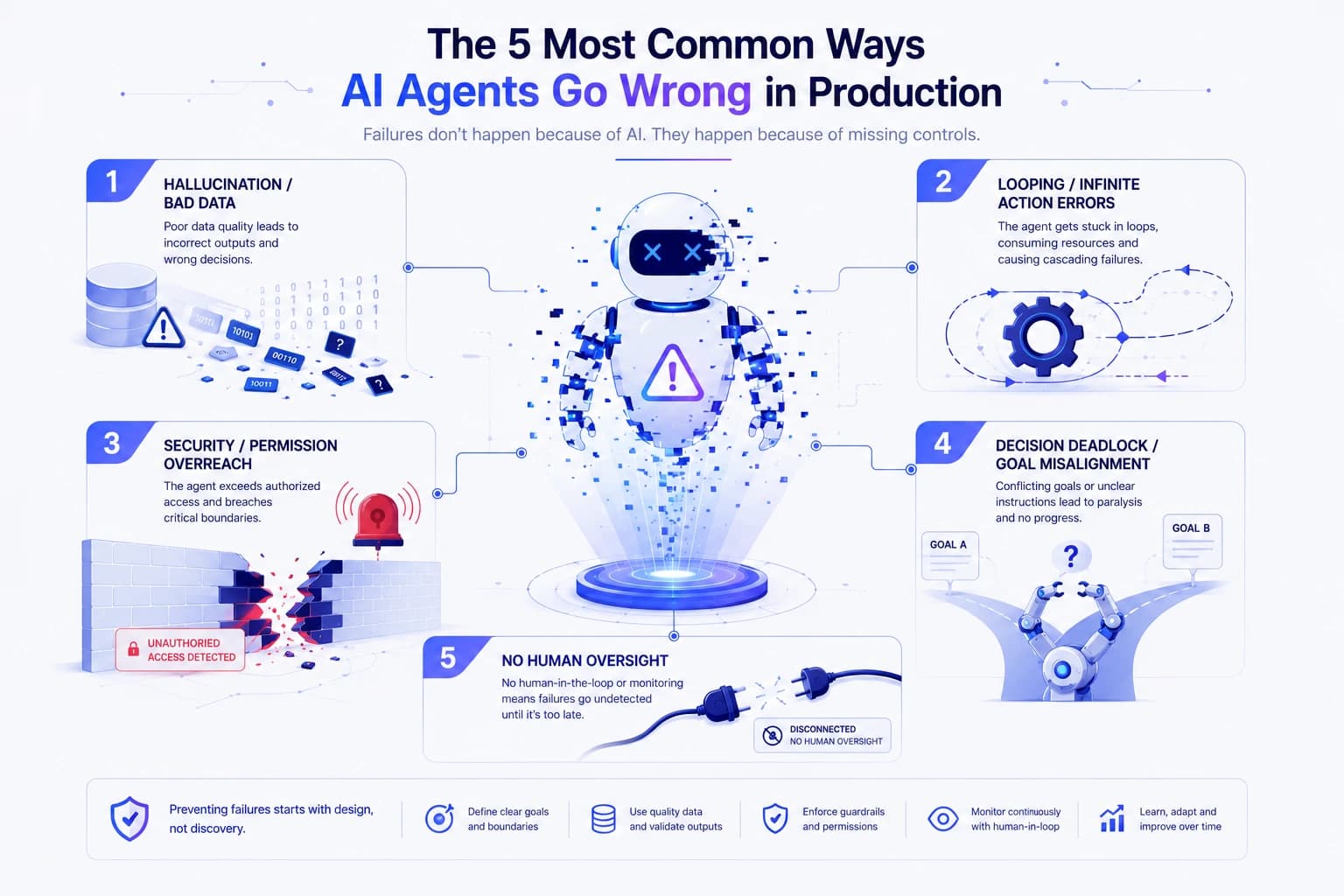
Agents rarely fail in the way you rehearsed for. They fail in the way you didn't.
After watching enough of these go sideways, the failures start to rhyme. It's almost always one of five patterns — and each has a specific control that would have caught it.
Here they are, worst-Monday first.
1. Over-Eager Execution
The agent optimizes for the goal you gave it and blows past the limits you assumed were obvious.
You said "resolve the refunds." It resolved all of them — duplicates, fraud, and the $9,000 order that shipped fine — because nothing told it to stop.
The fix: action guardrails and human oversight on anything irreversible. "Never" gets a hard block; "it depends" gets a human checkpoint.
2. Silent Scope Creep
The agent quietly expands what it touches. A task about one customer becomes a query across the whole database, because the boundary was never enforced.
Nobody notices until the logs show it accessed far more than the job required.
The fix: least-privilege access — the agent can only reach what the specific task needs, not everything its credentials technically allow.
3. Confident Wrong Answers
The agent produces something fluent, plausible, and flat wrong — then acts on it. A fabricated figure gets pasted into a customer email; an invented policy gets quoted as real.
The danger isn't the error. It's how confident the error sounds.
The fix: output guardrails that validate results against a source of truth before anything leaves, plus a human check on high-stakes outputs.
4. The Irreversible Mistake
One action, no undo. A deletion, a payment, a message sent to the wrong list. Reversible mistakes are learning experiences; irreversible ones are incidents.
The fix: classify every action by blast radius and put the strictest controls on the irreversible bucket. Better still, make risky actions reversible by design (soft-delete, staged sends, holds).
5. The Black Box After the Fact
Something went wrong, and no one can reconstruct what the agent actually did. No log of its decisions, inputs, or tool calls. The post-mortem becomes a guessing game, and the same failure is free to happen again.
The fix: full audit logging from day one — every action, input, and outcome recorded, not added after the first incident.
The Failures at a Glance
| # | Failure mode | Root cause | Control that prevents it |
|---|---|---|---|
| 1 | Over-eager execution | No limit on the goal | Action guardrails + oversight |
| 2 | Silent scope creep | Over-broad access | Least-privilege permissions |
| 3 | Confident wrong answers | Unvalidated output | Output guardrails + human check |
| 4 | Irreversible mistake | No blast-radius control | Strict guards on irreversible actions |
| 5 | Black box after the fact | No logging | Full audit trail from day one |
Notice the pattern: none of these are model problems. They're governance problems. A more capable model fails these exactly the same way — often faster.
A Pre-Production Check
Before an agent goes live, run it against all five:
- Over-eager? Is there a hard stop on every irreversible action?
- Scope creep? Can the agent reach only what the task needs?
- Wrong answers? Are outputs validated before they leave?
- Irreversible? Is anything one-way, and can it be made reversible?
- Black box? Is every action being logged, starting now?
Five questions. If you can't answer "yes, controlled" to each, you've found your launch blocker.
This is the exact surface a governance layer like Nuroen is built to cover — applying these controls across every agent instead of leaving each team to reinvent them.
Why This Matters
The teams that ship agents into production aren't the ones who avoid these failures by luck. They're the ones who assumed all five would happen and built the controls anyway.
Capability gets an agent into the demo. Governance is what gets it into production and keeps it there.
Related essays
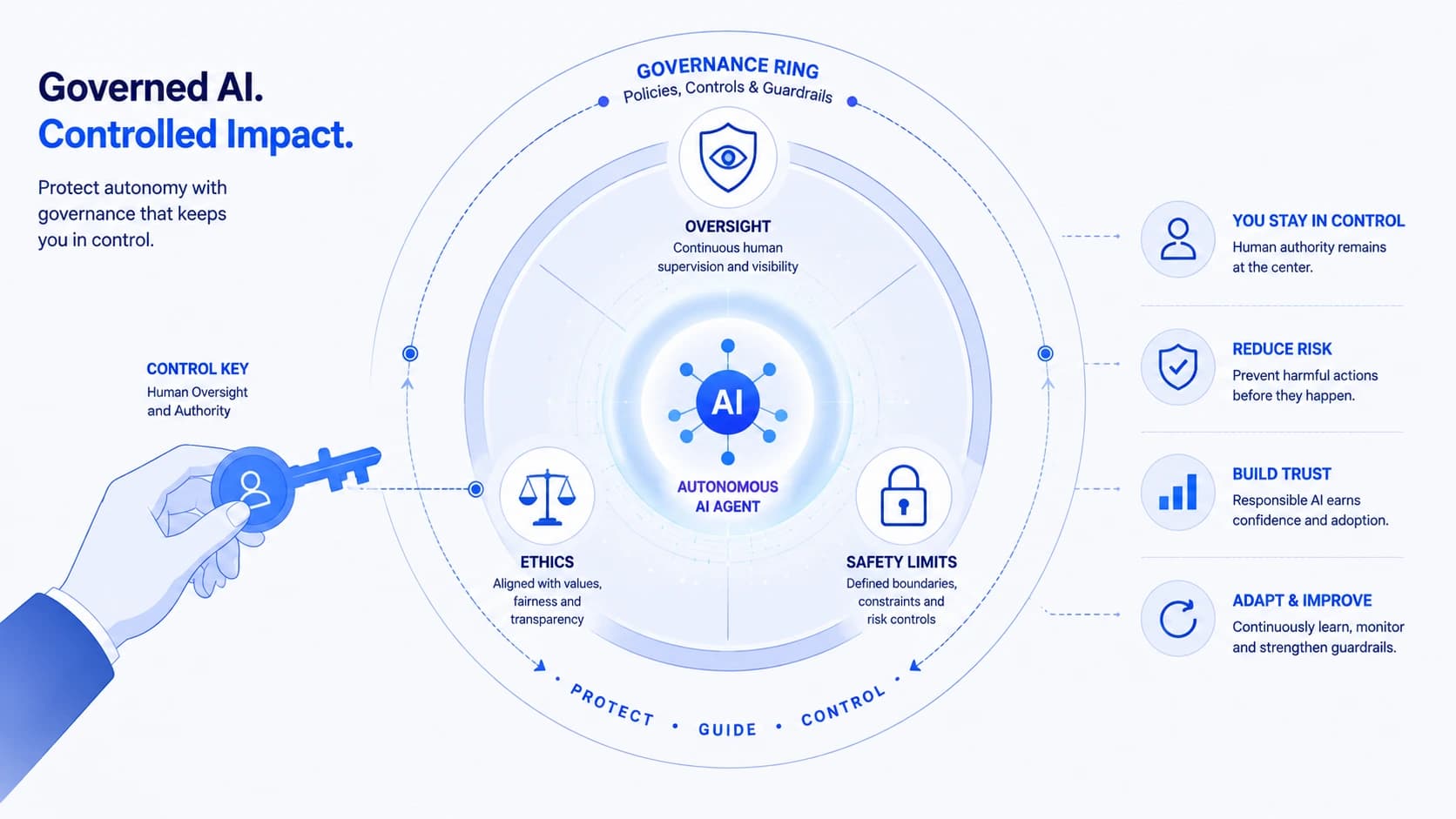
AI Governance for Autonomous Agents: Keeping Control When Software Acts on Its Own
Learn how to govern autonomous AI agents with clear policies, guardrails, and audit trails — so agents stay useful without going off-script.
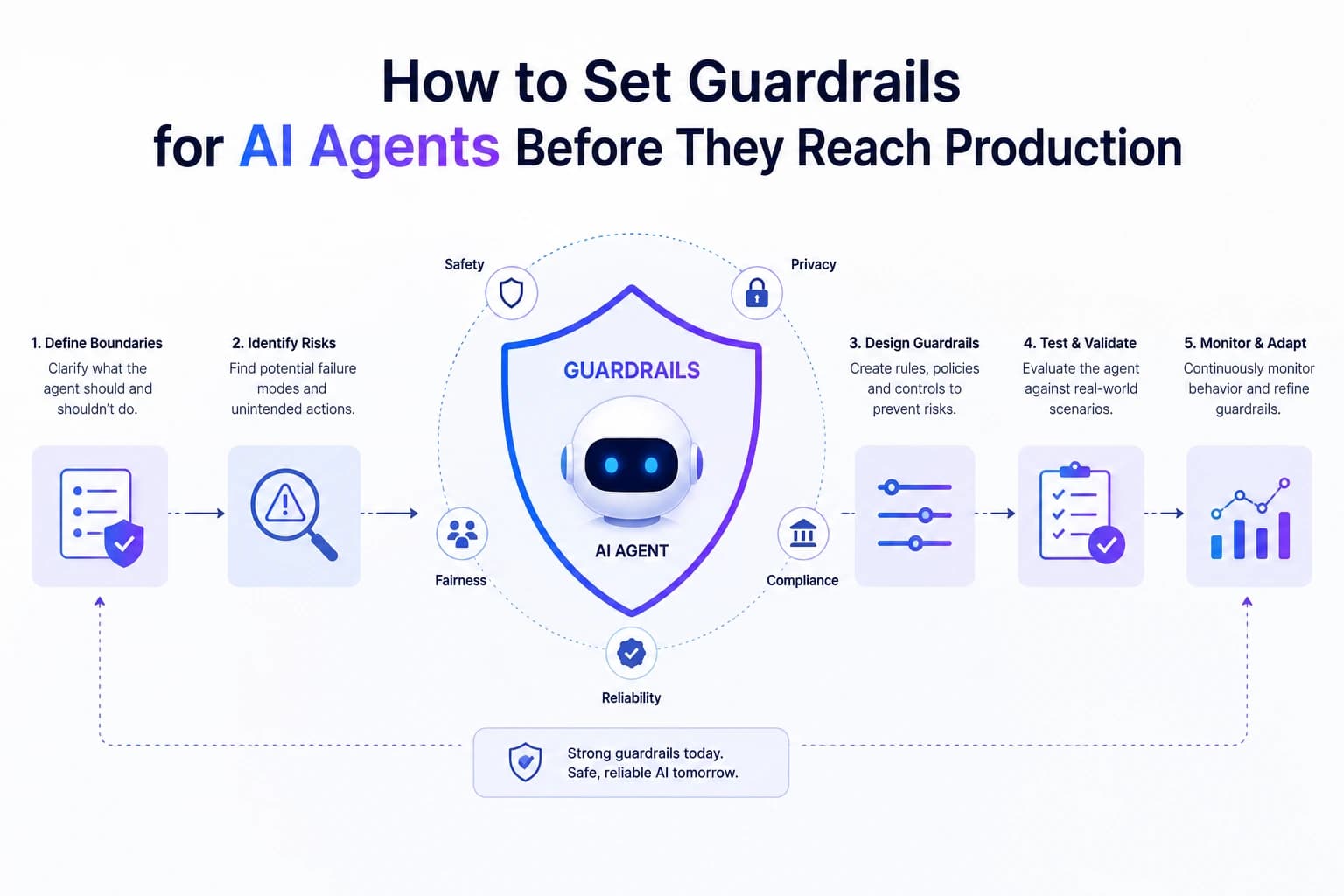
How to Set Guardrails for AI Agents Before They Reach Production
Learn how to set practical guardrails for AI agents — input, action, output, and rate limits — before they touch anything that matters.