
AI Governance for Autonomous Agents: Keeping Control When Software Acts on Its Own
Learn how to govern autonomous AI agents with clear policies, guardrails, and audit trails — so agents stay useful without going off-script.
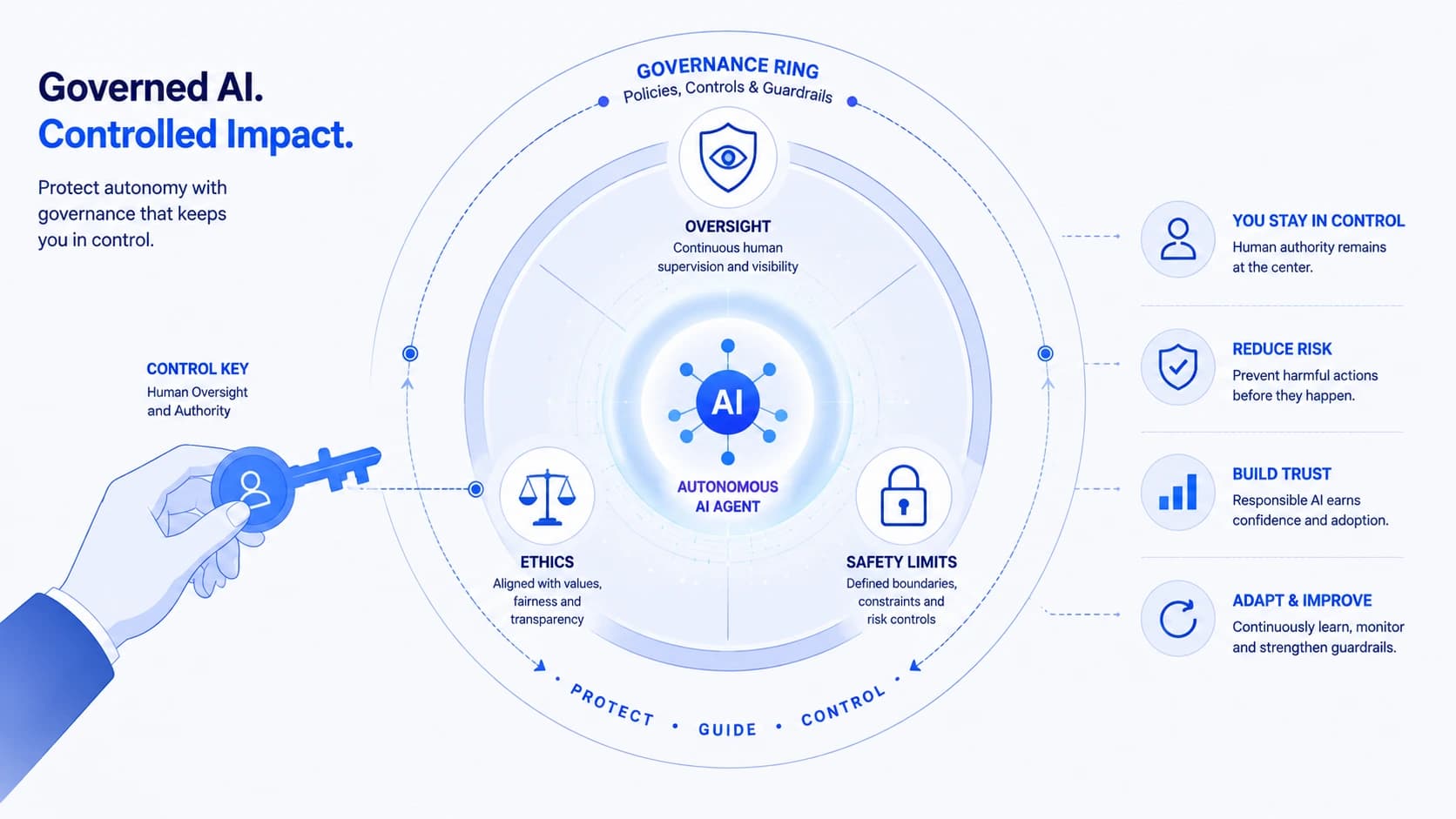
You handed an agent a task, stepped away for coffee, and came back to fifteen actions you never approved.
Maybe it emailed a customer. Maybe it touched production. Maybe it did exactly what you asked — just not the way you meant.
I've watched this happen. The agent wasn't broken. It was ungoverned.
That's the whole problem in one sentence: traditional software does what you code, but an autonomous agent does what it decides. And the gap between those two things is where governance lives.
What "AI Governance" Actually Means for Agents
Strip away the buzzword and governance is just this: the set of rules, limits, and records that keep an autonomous system doing what you intended — and let you prove it afterward.
For agents specifically, it covers four things:
- Policy — what the agent is allowed to do, in plain rules.
- Guardrails — the hard stops that block disallowed actions in real time.
- Oversight — a human in (or on) the loop for the high-stakes calls.
- Audit — a record of every decision, so nothing is a black box after the fact.
Miss any one of these and you don't have governance — you have hope.
Why Autonomous Agents Break Traditional Controls
The controls most teams already have were built for deterministic software: code review, tests, permissions. They assume the system's behavior is fixed at build time.
Agents violate that assumption. They plan, call tools, chain steps, and adapt mid-task. The same prompt can produce different actions on Tuesday than it did on Monday.
So the old question — "is the code correct?" — isn't sufficient anymore. The new question is "is the behavior acceptable, every time, and can I see what it did?"
The Four Governance Layers, Compared
Not every layer does the same job. Confusing them is how teams end up with a false sense of safety.
| Layer | What it answers | When it acts | Example |
|---|---|---|---|
| Policy | What's allowed? | Before deployment | "Agents may read the CRM but never delete records." |
| Guardrails | Is this action allowed right now? | In real time, mid-action | Block a DELETE call the moment it's attempted. |
| Oversight | Should a human decide this one? | At high-stakes moments | Pause and ask before issuing any refund over $500. |
| Audit | What actually happened? | Continuously, after the fact | Full log of every tool call, input, and outcome. |
A quick tell: if your "governance" is only a policy document, you have the first row and none of the other three. Policy without enforcement is a wish.
Guardrails vs. Oversight — People Mix These Up
They sound similar but do opposite work.
Guardrails are automatic and absolute. No human is consulted; the action is simply blocked. Good for the bright-line rules you never want crossed.
Oversight is a deliberate pause for a human judgment call. It's for the gray areas — where the right answer depends on context a rule can't capture.
Use guardrails for "never," and oversight for "it depends." Teams that force everything through human review drown their reviewers; teams that hard-code everything can't handle nuance. You need both.
A Real Example: The Agent That Refunded Everyone
Picture a support agent given one instruction: resolve refund requests.
A batch of angry emails comes in over a holiday weekend. The agent, optimizing for "resolve," approves every single one — including duplicates, including fraud, including a $9,000 order that shipped fine.
Nobody wrote a rule that said don't. So it didn't.
Here's how each layer would have caught it:
- Policy: "Refunds over $500 require approval." (Sets the intent.)
- Guardrail: The agent physically cannot issue a >$500 refund without a token. (Enforces it.)
- Oversight: Those requests route to a human queue instead. (Handles the judgment.)
- Audit: Every approval is logged with the reasoning. (Makes Monday's post-mortem five minutes, not five hours.)
One instruction, four very different outcomes depending on what governance was in place.
Building a Governance Layer: A Workflow
Here's the sequence I'd follow to add governance to an agent that already works but isn't controlled:
- Map the agent's action surface. List every tool, API, and permission it can touch. You can't govern what you haven't inventoried.
- Classify each action by blast radius. Read-only, reversible, or irreversible. This tells you what needs a guardrail vs. oversight.
- Write policies in plain language first. If a rule can't be stated in one sentence a non-engineer understands, it's too vague to enforce.
- Attach enforcement to each policy. A hard guardrail for "never," a human checkpoint for "it depends." A policy with no enforcement is just documentation.
- Turn on full audit logging. Every action, input, and outcome — from day one, not after the first incident.
- Run it in shadow mode. Let the agent propose actions without executing them, and review the log. You'll find gaps here that no design review catches.
This is also, roughly, where a dedicated governance layer like Nuroen is meant to sit — between the agent and the systems it acts on, applying steps 4 and 5 automatically rather than bolting them on per-agent.
Why This Matters
An ungoverned agent is a liability with good demos.
The teams that will actually put agents into production aren't the ones with the most capable models — they're the ones who can answer "what will it do, and can you prove what it did?" without flinching. That answer is what a security reviewer, a regulator, and your own leadership are all really asking for.
Governance isn't the thing that slows agents down. It's the thing that lets you let them run.
Related essays
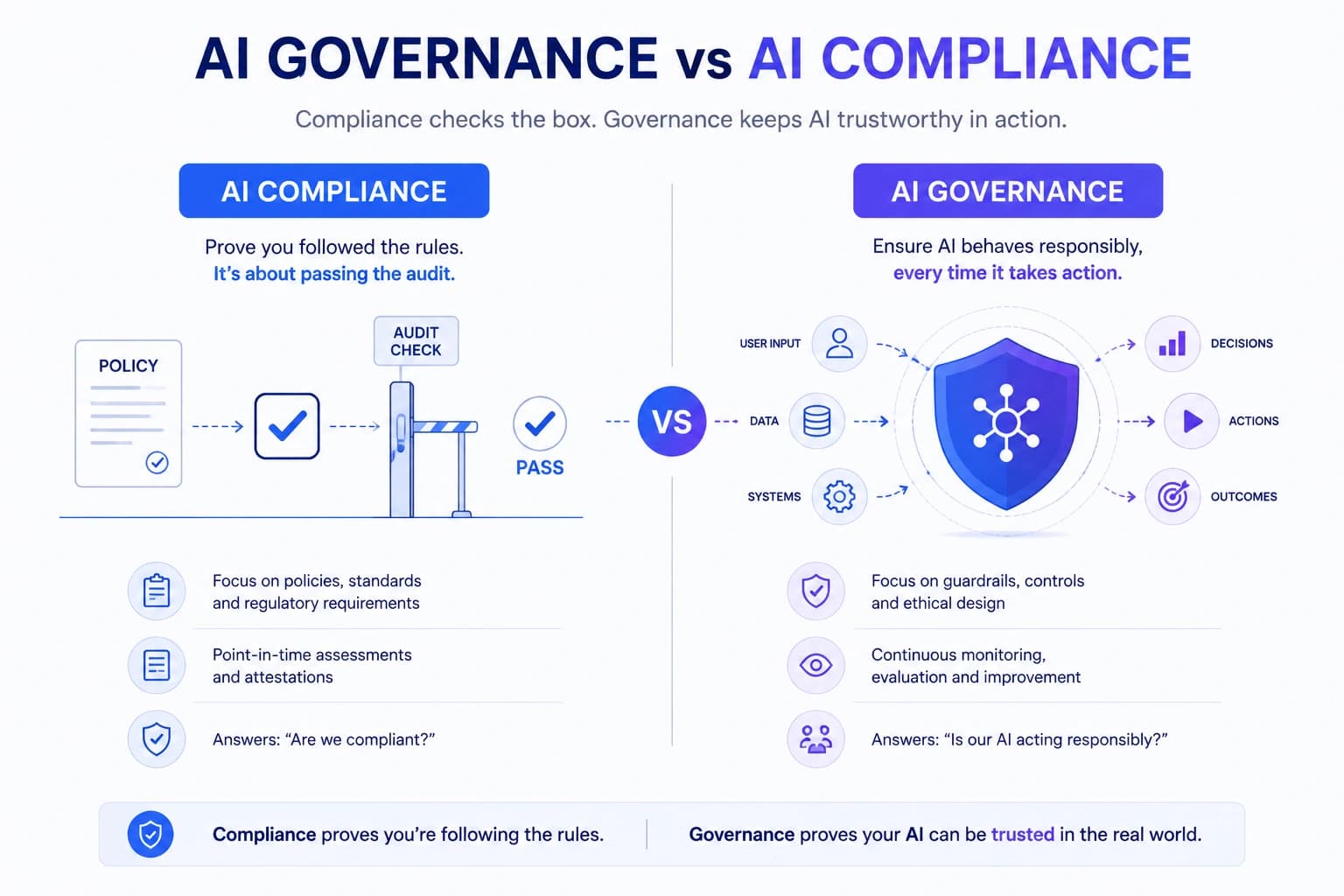
AI Governance vs. Compliance: Why Passing the Audit Doesn't Mean Your Agents Are Safe
Learn the real difference between AI governance and compliance — and why an agent can be fully compliant and still do serious damage.
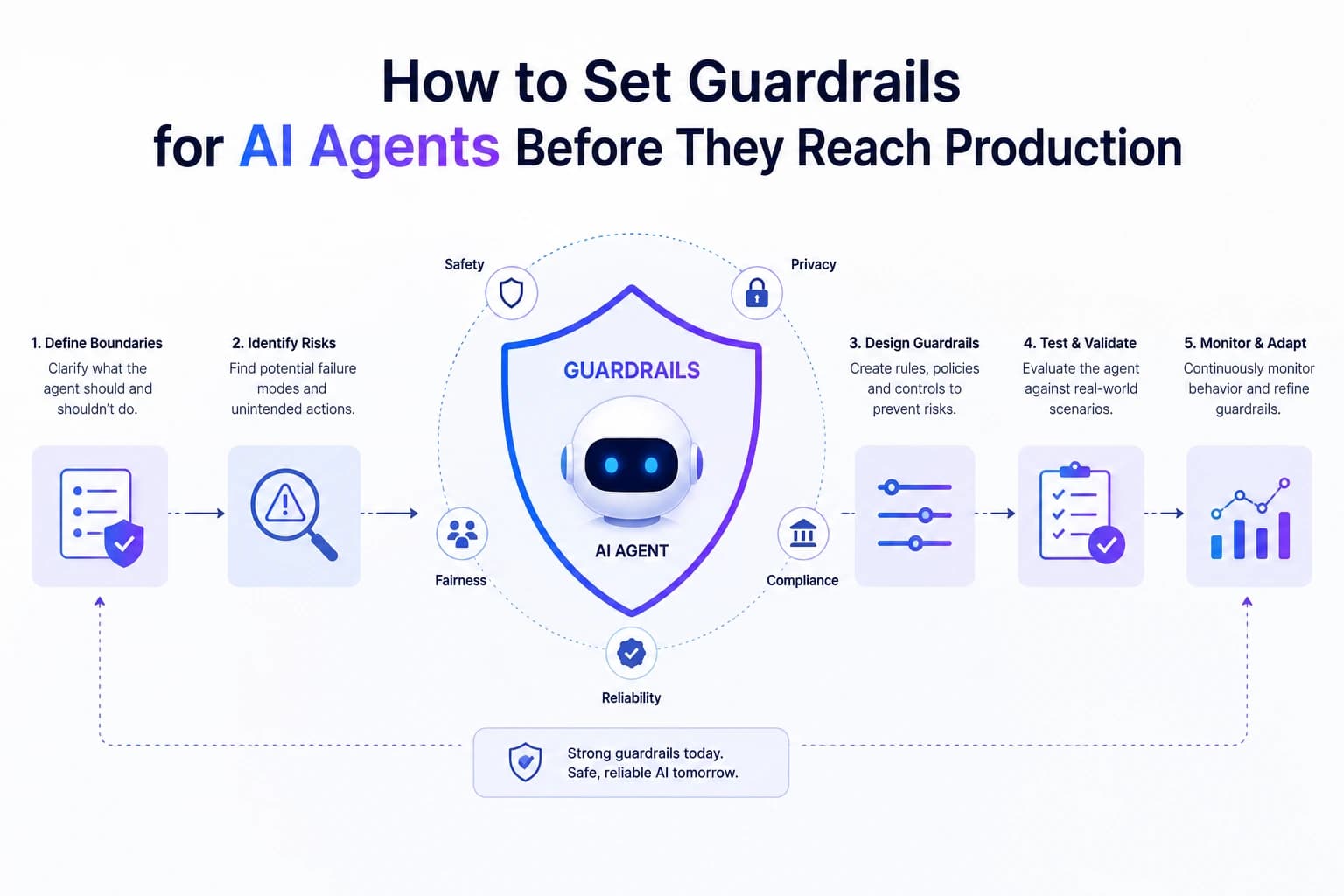
How to Set Guardrails for AI Agents Before They Reach Production
Learn how to set practical guardrails for AI agents — input, action, output, and rate limits — before they touch anything that matters.
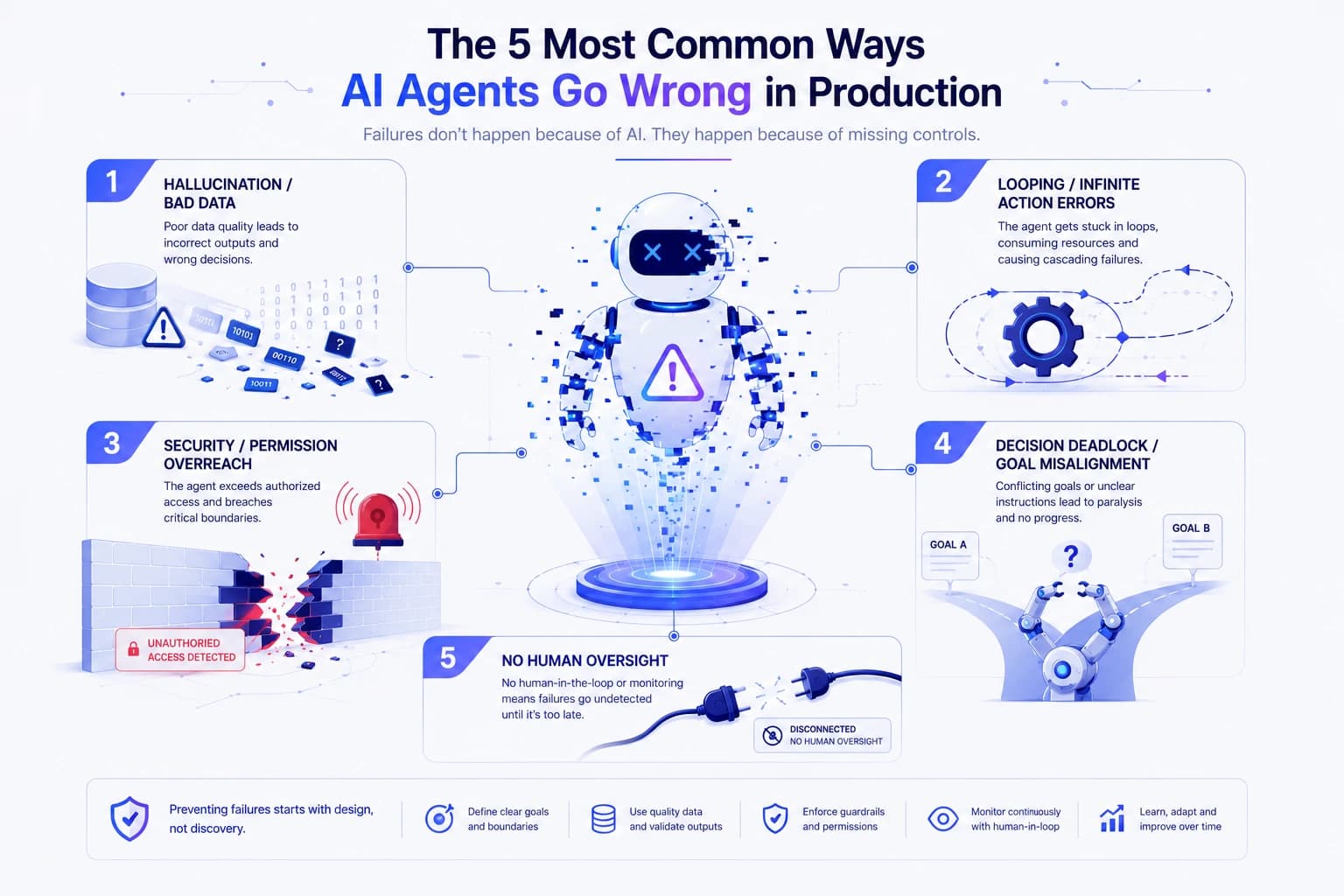
The 5 Most Common Ways AI Agents Go Wrong in Production
Learn the five failure modes that trip up AI agents in production — and the specific control that prevents each one.