
How Agentic AI Automates Equipment Incident Investigation and Maintenance Workflows
Learn how to use agentic AI to investigate equipment incidents, retrieve maintenance knowledge, and coordinate safer repair workflows.
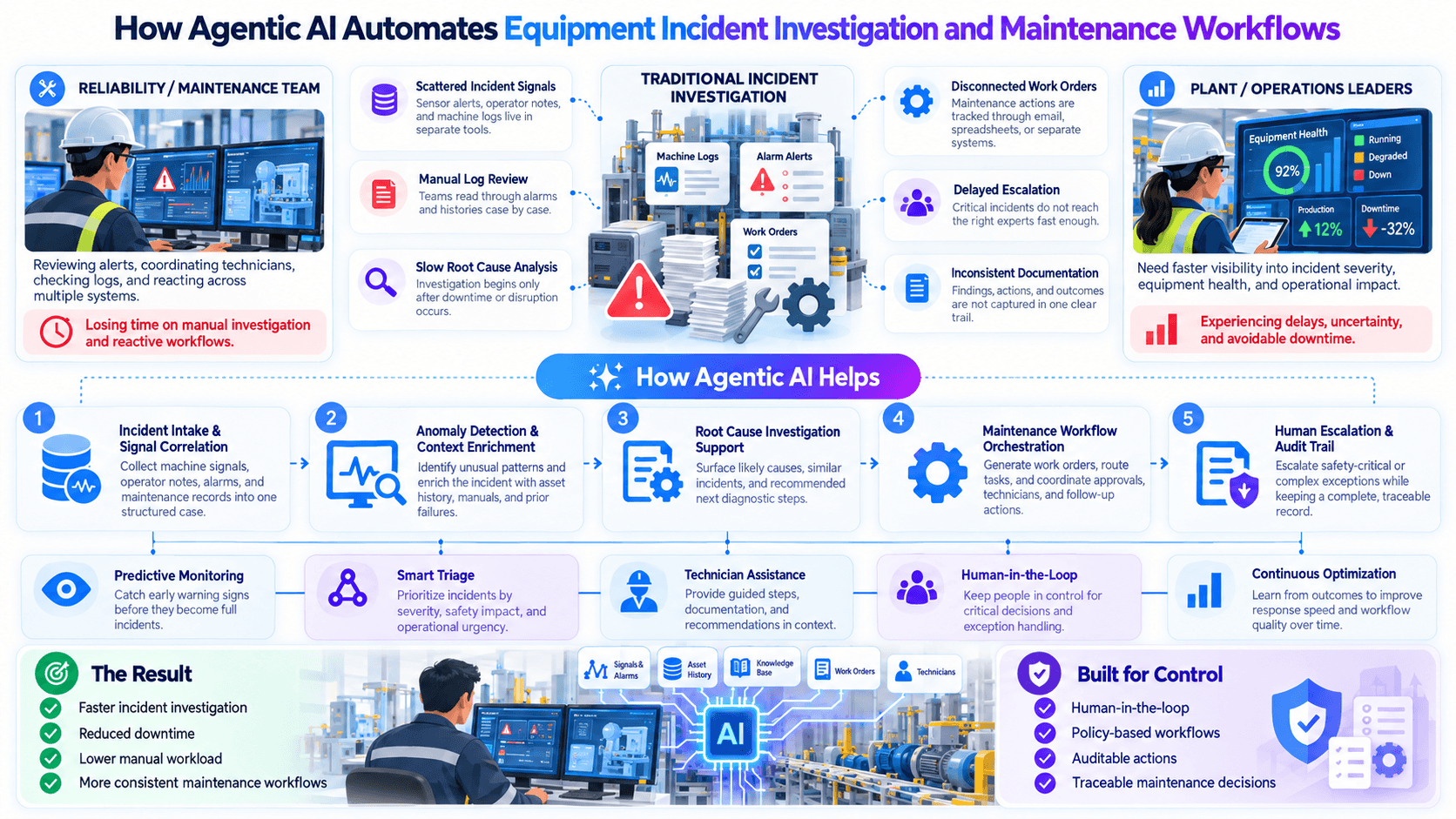
I've seen how a single equipment alarm can turn into an hour of searching.
Someone checks the machine history. Someone else hunts for the latest maintenance procedure. The reliability engineer is pulled into a thread with half the context missing.
The repair may be urgent, but the investigation is still manual.
That's the gap agentic AI can help close: connecting equipment incident investigation and maintenance workflows so teams spend less time assembling information and more time making informed decisions.
The real bottleneck isn't always the repair
When equipment behaves unexpectedly, maintenance teams rarely begin with a complete picture. Critical context may be scattered across alarm logs, operator notes, work orders, equipment manuals, and previous incident reports.
Consider the questions that arise after a repeated motor overload alert:
- Has this alarm occurred before, and under what operating conditions?
- Was maintenance recently performed on the asset?
- Which troubleshooting procedure applies to this equipment model?
- Is there an active work order or an unresolved recommendation?
- Who is authorized to approve the next action?
Finding reliable answers can mean switching between systems and asking colleagues for missing details. The problem is not a lack of data. It is the effort required to turn fragmented records into a usable incident picture.
What agentic AI changes in maintenance investigation
Traditional automation is effective when the next step is fixed: an alert triggers a ticket, a ticket triggers an email, and a technician receives a task.
An agentic workflow can go further. It can coordinate bounded tasks such as collecting evidence, retrieving a relevant procedure, identifying missing information, and preparing a structured incident summary for human review.
This is not the same as giving software permission to diagnose a machine or authorize a repair independently. A useful maintenance agent supports the decision process; it does not replace technical judgment, plant safety rules, or required sign-off.
Nuroen AI's multi-agent coordination can help organize this work into distinct responsibilities rather than one broad, difficult-to-audit task.
| Investigation activity | Fragmented manual approach | Coordinated agent-assisted approach |
|---|---|---|
| Initial context | Engineer opens several systems individually | Workflow assembles available incident details in one record |
| Equipment history | Search past work orders and notes manually | Retrieval step surfaces relevant historical records for review |
| Procedure lookup | Find and verify the correct document | Knowledge retrieval brings forward potentially applicable guidance with source references |
| Missing information | Discovered late in the investigation | Workflow flags gaps before a recommendation is prepared |
| Decision and execution | Context shared across messages and handoffs | Human reviewer receives a structured summary and approves next steps |
The agent-assisted column describes a proposed workflow design, not a claim that every data source or action is already configured in a plant.
Connect evidence before drawing conclusions
Maintenance teams need traceable evidence, especially when an incident affects production or safety. An agent-generated statement such as “bearing failure is likely” is not useful unless the engineer can see the supporting information and its limitations.
A well-designed investigation should distinguish among:
- Observed facts: alarm time, asset identifier, recorded operating condition, and verified work-order history.
- Retrieved guidance: the relevant troubleshooting procedure, including revision or effective date where available.
- Possible explanations: hypotheses that require human validation or additional measurements.
- Unknowns: missing sensor readings, conflicting records, or inaccessible sources.
This is where knowledge retrieval matters. Nuroen AI can be used to bring relevant maintenance documentation into the investigation workflow, provided the organization supplies approved, current source material and validates access to it.
Treat retrieved content as evidence to examine—not as unquestionable instructions.
One example: a recurring pump vibration alarm
Imagine a centrifugal pump at a manufacturing plant triggers a high-vibration alarm during a production shift. The operator reports an unusual sound, but the asset is still running.
The usual response may involve several calls: operations shares the alert, maintenance checks the asset, and reliability searches prior incidents and the pump manual.
In an illustrative agent-assisted workflow, the system receives the asset ID and alert details. One task retrieves recent incident notes; another finds the applicable pump troubleshooting procedure; a third checks whether an open maintenance work order already exists. The coordinating agent builds a review packet:
- Alarm details and incident time
- Relevant historical events and open work orders
- Applicable procedure references
- Evidence gaps, including measurements still required
- Recommended investigation steps for human assessment, not an autonomous repair command
The reliability engineer compares the packet with on-site observations, follows plant procedures, and decides whether the equipment can continue operating or must be isolated. Any lockout/tagout, inspection, or restart action remains under the plant's established authorization process.
The value is simple: the engineer starts with better organized context, while the authority to act stays where it belongs.
Where multiple agents help—and where they don't
Not every plant needs a large agent hierarchy. A small workflow may only need a trigger, a retrieval step, and a summary.
Multiple focused agents become useful when different steps need different data, tools, or review boundaries. A possible division of responsibilities is:
- Incident intake: captures the asset, event, timestamp, and reported symptoms.
- History lookup: finds relevant prior incidents and work orders.
- Knowledge lookup: retrieves approved troubleshooting documentation.
- Investigation coordinator: reconciles the findings, identifies gaps, and prepares a human-readable summary.
Nuroen AI's tool integration approach can provide a way to connect these responsibilities to enterprise systems. Before implementation, however, the team must verify which systems, actions, permissions, and data formats are actually supported in the target environment. Do not assume that a connector can write to a maintenance system simply because it can read from it.
Build safety and accountability into the workflow
A maintenance assistant is credible only if teams can understand how it reached its output and stop it from taking an unsuitable action.
Use these guardrails in the design:
- Start with read-only investigation; introduce write actions only after permissions and controls are tested.
- Keep emergency shutdown, isolation, repair authorization, and equipment restart outside autonomous execution unless a separately validated safety system governs them.
- Require engineers to verify source documents, equipment identity, and the freshness of records.
- Show uncertainty and missing evidence rather than forcing a confident-looking diagnosis.
- Record the evidence considered, the person reviewing it, and the approved next action.
- Test failures deliberately: missing records, incorrect asset IDs, conflicting documents, and unavailable tools.
These practices help make an assistant operationally useful without confusing workflow coordination with control-system authority.
A practical seven-step maintenance workflow
Start with one common, well-understood class of incident rather than automating all maintenance activity at once.
- Define the trigger. Select an incident type, such as a vibration alert, and specify which event details are required.
- Identify approved sources. List the equipment records, work orders, and maintenance procedures that teams may consult.
- Verify tool access. Confirm available read actions and test that retrieved records match the requested asset.
- Retrieve evidence. Pull incident context and documents, preserving source identifiers and timestamps where available.
- Compile the review packet. Separate verified observations, relevant guidance, hypotheses, and information gaps.
- Route to the responsible engineer. Require a human to assess the packet and decide on inspection, escalation, or another action.
- Capture the outcome. Record the engineer's disposition in the approved system or review process, and use the case to improve subsequent workflows.
Nuroen AI's multi-agent coordination, knowledge retrieval, and tool integrations are relevant at the evidence-gathering and coordination steps. The final scope depends on the systems and permissions the plant has actually approved.
What to measure before expanding
Run a controlled pilot and compare the agent-assisted process with the existing workflow. Useful measures include:
- Time spent assembling an incident review packet
- Percentage of retrieved records that refer to the correct asset
- Number of missing or outdated procedure references
- Engineer corrections required before approval
- Percentage of cases escalated because evidence was insufficient
Publish improvement figures only after measurement. [BENCHMARK: insert validated pilot baseline, sample size, measurement period, and result if available.]
Why this matters
Maintenance credibility is earned through evidence, not confident prose. An incident investigation has real consequences: production continuity, equipment health, and worker safety.
Agentic AI can make maintenance workflows more coherent by gathering context, retrieving knowledge, and organizing handoffs. Its contribution is strongest when engineers can check the evidence, challenge the output, and retain authority over physical actions.
To see how that approach could be structured for your environment, Explore the Manufacturing Workflow Demo. [CTA URL: replace with the verified manufacturing demo or landing-page link before publication.]
Placeholders to complete before publishing
- [BENCHMARK] — Optional: add independently validated pilot performance data, including baseline and sample size; otherwise remove the sentence.
- [CTA URL] — Replace the temporary Nuroen homepage link with the confirmed Manufacturing Workflow Demo URL.
- [IMAGE] (two slots) — Create and review both visual assets, using an explicit “illustrative” label on the sample incident packet.
Related essays
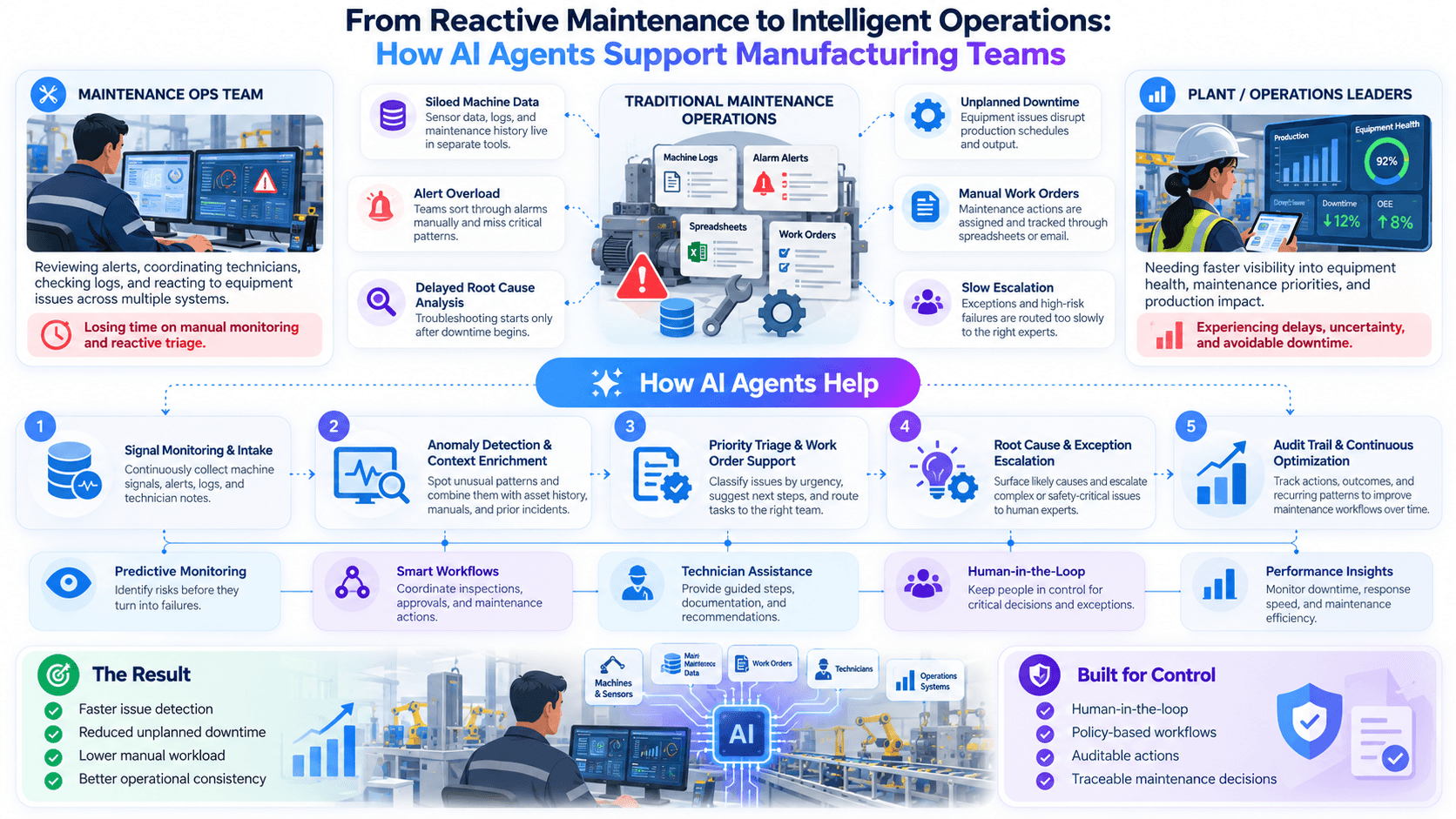
From Reactive Maintenance to Intelligent Operations: How AI Agents Can Support Manufacturing Teams
Learn how AI agents can help manufacturing teams coordinate maintenance, data, workflows, and operational decisions with greater consistency.
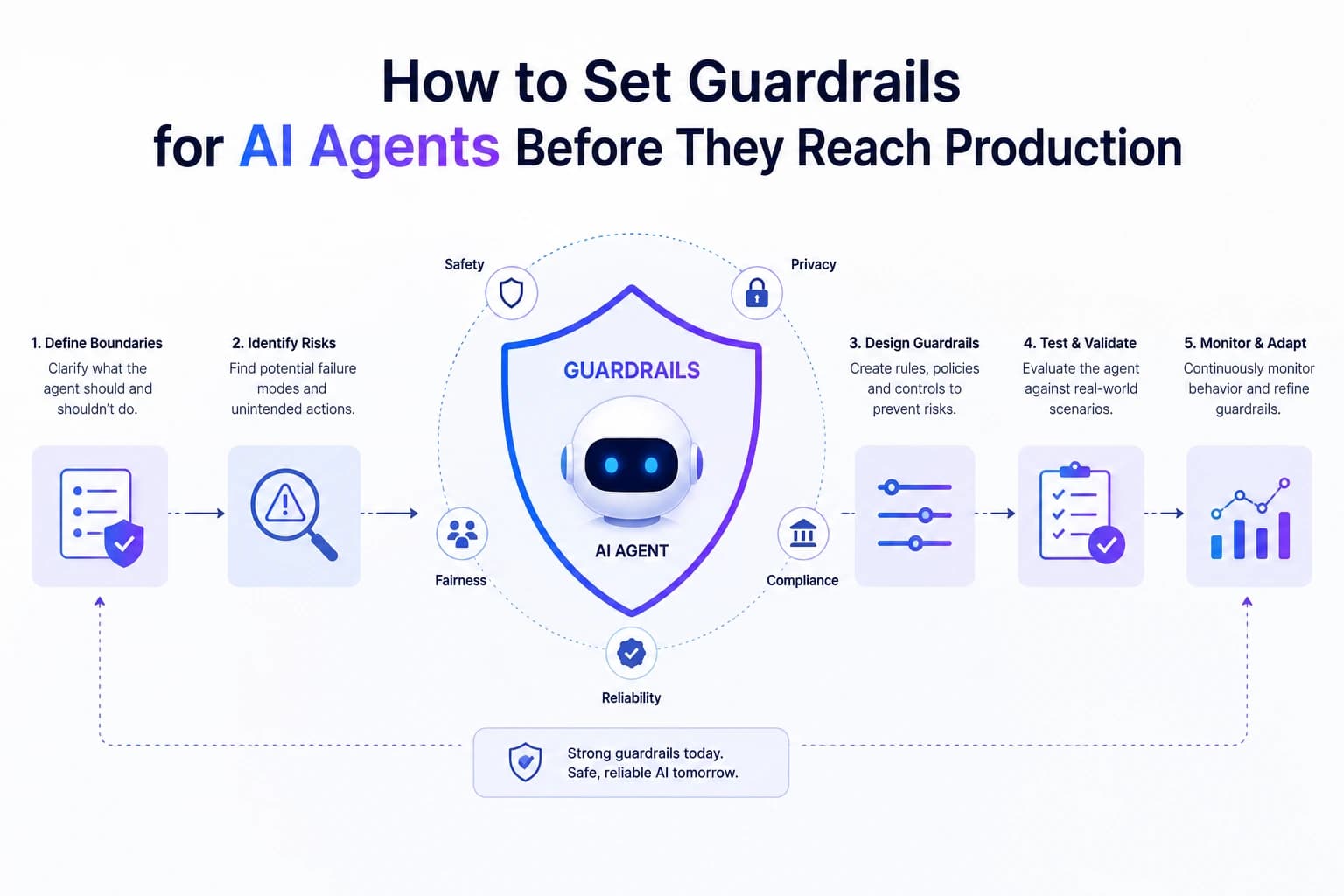
How to Set Guardrails for AI Agents Before They Reach Production
Learn how to set practical guardrails for AI agents — input, action, output, and rate limits — before they touch anything that matters.