
From Reactive Maintenance to Intelligent Operations: How AI Agents Can Support Manufacturing Teams
Learn how AI agents can help manufacturing teams coordinate maintenance, data, workflows, and operational decisions with greater consistency.
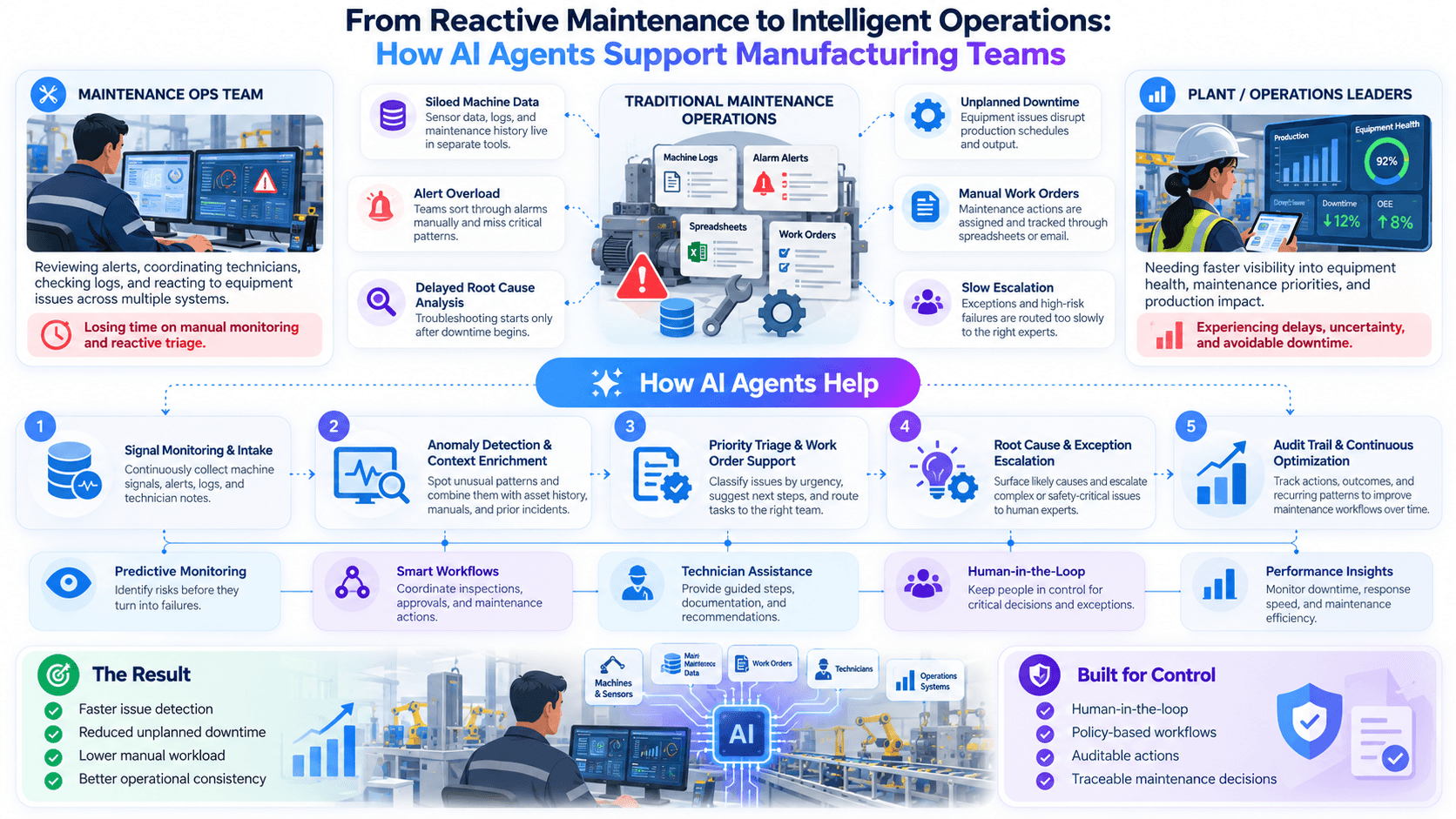
I’ve seen plant teams lose valuable time not because nobody knew there was a problem, but because the right information reached the right person too late.
An alert fires. Someone checks the machine. Maintenance looks for history. Operations checks production impact. Another team searches for the latest procedure.
The failure may take minutes to detect.
The response can take much longer to coordinate.
That is where AI agents in manufacturing can become useful: not by replacing operators or engineers, but by helping teams connect operational data, workflow steps, and human decisions faster.
Reactive Maintenance Is Really a Coordination Problem
When equipment fails, the visible problem is the machine.
The operational problem is everything that follows.
Teams may need to determine:
- what happened
- which asset is affected
- whether the issue has happened before
- what maintenance history exists
- whether production should continue
- which procedure applies
- what downstream process is at risk
- whether spare parts are available
- who needs to be informed
- whether the issue requires escalation
- what action should happen next
A single incident can touch maintenance, production, engineering, quality, inventory, and management.
That means the bottleneck is often not diagnosis alone.
It is coordination.
Why Traditional Manufacturing Workflows Stay Reactive
Many plants already have digital systems.
That does not automatically make operations intelligent.
The problem is often fragmentation.
An alert may tell the team that something is wrong.
It may not explain:
- what changed
- what related data matters
- whether the issue is recurring
- what happened the last time
- who owns the response
Someone still has to investigate.
Maintenance records, production data, operating procedures, inventory information, and incident records may exist in separate places.
A technician or supervisor may need to move between them manually.
Experienced operators often know which signal matters, whom to call, and which workaround is safe.
That knowledge is valuable.
It is also difficult to scale when it remains informal.
Maintenance can diagnose the issue while operations waits.
Operations can identify production impact while procurement waits.
Each team may be doing its job correctly while the overall response still moves slowly.
Routine events may have established procedures.
Unusual events often create ad hoc coordination through calls, chat messages, spreadsheets, and email.
That is where workflow automation starts to matter.
Reactive Operations vs. Agent-Orchestrated Operations
The difference is not simply “manual versus AI.”
It is the difference between people coordinating every step themselves and an intelligent workflow coordinating routine steps while humans retain control of important decisions.
| Operational activity | Reactive approach | Agent-orchestrated approach |
|---|---|---|
| Alert received | Operator sees an alarm | Workflow begins investigation and context gathering |
| Asset context | Technician searches records manually | Agent prepares relevant asset and incident context |
| Maintenance history | Separate lookup | Workflow retrieves relevant historical information |
| Production impact | Operations team investigates | Agent prepares affected process or schedule context |
| Procedure lookup | Manual search | Workflow surfaces the relevant operating information |
| Escalation | Calls, messages, or email | Defined routing sends the case to the right person |
| Next action | Human coordinates every transition | Orchestrator routes the workflow based on outcomes |
| Execution | Manual follow-through | Workflow automation can coordinate approved tasks |
| Human judgment | Human | Human where operational authority requires it |
The goal is not to automate every plant decision.
It is to reduce the amount of human effort spent moving information between decisions.
AI Agents Should Support Operators, Not Compete With Them
Manufacturing is not a good environment for uncontrolled autonomy.
Equipment, people, quality, safety, and production commitments are connected.
An AI agent should therefore have a bounded role.
Good candidates include:
- collecting relevant operational context
- summarizing recent events
- checking maintenance history
- preparing incident information
- identifying missing data
- routing tasks
- coordinating workflow steps
- preparing options for human review
- tracking whether required actions have been completed
Humans should remain responsible where judgment, safety, authorization, or local operating knowledge matters.
That division of responsibility is important.
The strongest agentic workflows are not the ones that remove humans.
They are the ones that help humans make informed decisions with less friction.
What a Multi-Agent Manufacturing Workflow Could Look Like
A complex plant event should not necessarily be handled by one giant AI agent.
Different responsibilities can be separated.
Receives an operational alert or maintenance issue and establishes the basic case context.
Collects relevant information about the affected asset, its recent events, and available history.
Prepares maintenance history, related work, and relevant maintenance context.
Assesses which production process, order, or operating area may be affected based on the available enterprise data.
Surfaces the relevant operating or maintenance information for the team.
Tracks the next required actions, dependencies, and handoffs.
Reviews decisions that should remain under operational authority.
Coordinates the sequence and determines which agent or workflow runs next.
This is where Nuroen AI Agent Orchestration can help: instead of forcing one agent to understand every operational responsibility, different agents can handle narrower tasks and pass structured context through the workflow.
Enterprise Data Is What Makes the Workflow Useful
An agent without operational context is limited.
Manufacturing decisions depend on data from across the business.
That might include:
- asset records
- maintenance history
- operating documentation
- production information
- inventory context
- quality records
- incident history
- other enterprise information relevant to the workflow
The important point is not how many systems are connected.
It is whether the workflow can get the information needed for the current decision.
Nuroen AI Enterprise Data Integration can support this step by allowing agent workflows to work with enterprise information rather than operating only from a user prompt.
The useful pattern is:
Operational event
→ gather relevant context
→ prepare a structured view
→ determine the next workflow step
→ send the case to the right agent or human
Data integration is valuable because it gives the workflow context.
It should not be treated as an end in itself.
Workflow Automation Turns Insight Into Action
Many industrial AI initiatives stop at detection.
A system says:
> “This machine may have a problem.”
That is useful.
But the plant still has to respond.
A stronger workflow asks:
- What should happen next?
- Who should own it?
- What information do they need?
- What dependencies need to be checked?
- What happens if the first action does not resolve the issue?
This is where Nuroen AI Workflow Automation can help.
For example:
Equipment event detected
→ gather asset context
→ retrieve maintenance history
→ assess production impact
→ prepare recommended response
→ human review where required
→ route approved actions
→ track completion
The operational value comes from connecting analysis to the next controlled step.
A Concrete Example: A Packaging Line Stops Mid-Shift
Consider a fictional packaging plant.
One production line stops unexpectedly during a busy shift.
The team needs to determine whether the issue can be resolved quickly or whether production needs to move elsewhere.
The supervisor may:
- check the alert
- contact maintenance
- identify the affected machine
- search for previous incidents
- ask whether spare parts are available
- check how long the line can remain offline
- determine which orders are affected
- contact the production manager
- search for the relevant procedure
- decide whether to repair, reroute, or escalate
None of these actions is unreasonable.
The delay comes from stitching them together under pressure.
The Event Intake Agent receives the issue.
The Asset Context Agent prepares relevant machine information.
The Maintenance Agent surfaces prior maintenance context.
The Production Impact Agent prepares the likely operational impact based on available data.
The Procedure Agent provides the relevant operating information.
The orchestrator brings the results together.
The plant supervisor then receives a structured view of:
- what happened
- what information is available
- whether a similar issue exists in history
- which operations may be affected
- what information still needs confirmation
- which next actions are available
The supervisor still decides.
But the investigation is better prepared.
That is the practical difference between an AI alert and an AI-supported operations workflow.
Intelligent Operations Requires More Than Predictive Maintenance
Predictive maintenance gets a lot of attention.
But maintenance is only one part of plant operations.
A real incident can affect:
- production planning
- quality
- inventory
- maintenance
- staffing
- delivery commitments
- safety procedures
- management reporting
An intelligent operations architecture needs to coordinate across those boundaries.
That is why the concept of agent orchestration matters.
Instead of building a separate isolated automation for every department, teams can define agents around operational responsibilities and let an orchestrator coordinate them when an event spans several areas.
Design the Workflow Around Escalation
The happy path is easy.
Industrial operations are defined by what happens when the happy path fails.
Teams should explicitly design for:
- missing data
- conflicting sensor or system information
- unresolved maintenance issues
- repeat failures
- unavailable parts
- unclear operating procedures
- production-impact uncertainty
- actions requiring supervisor approval
- cases that cannot be resolved automatically
For each exception, define:
- what causes the workflow to stop
- what data should be preserved
- who receives the issue
- what information they need
- what action allows the workflow to resume
- whether the issue should remain open for follow-up
A reliable workflow knows when not to proceed.
Keep Recommendation and Authority Separate
This is especially important in industrial environments.
An agent can help prepare:
- likely causes
- relevant history
- possible next actions
- operating context
- workflow dependencies
That does not mean it should always have authority to act.
The organization should decide:
- which actions may be automated
- which actions require confirmation
- which decisions require supervisor approval
- which situations should always escalate
Nuroen AI Workflow Automation and Agent Orchestration can support this separation by keeping the workflow moving while still leaving defined decisions with plant personnel.
That is a much safer model than equating intelligence with autonomy.
What Manufacturing Leaders Should Define Before Building
Before introducing agents into plant workflows, document the operational boundaries.
A practical checklist includes:
- what events should trigger a workflow
- which data sources are required
- what each agent is responsible for
- which tasks can run automatically
- what counts as an exception
- who owns each escalation path
- which actions require human approval
- what information must be passed between teams
- what happens when required data is unavailable
- when a workflow should stop instead of guessing
The clearer these boundaries are, the easier the system is to operate and trust.
Step-by-Step: Moving From Reactive Maintenance to Intelligent Operations
A practical transformation can start with one bounded operational workflow.
Start with a problem teams already understand well.
Examples might include:
- repeated equipment downtime
- maintenance-event coordination
- production interruption
- recurring incident investigation
Avoid trying to automate the entire plant at once.
Document what actually happens from the first alert to final resolution.
Include:
- people involved
- systems checked
- data collected
- decisions made
- approval points
- handoffs
- common delays
Define narrow agent roles.
For example:
- event intake
- asset context
- maintenance history
- production impact
- procedure retrieval
- coordination
Use Nuroen AI Agent Orchestration to connect those responsibilities into one flow.
Identify the minimum information each agent needs.
Use Enterprise Data Integration only where a workflow step requires that data.
Avoid connecting systems without a clear operational purpose.
For every important outcome, specify the next step.
For example:
Issue understood → continue
More information required → gather context
Production impact detected → notify operations
Human decision required → escalate
Unresolved → keep incident open
Use Nuroen AI Workflow Automation to coordinate predictable tasks and handoffs.
Keep operational authority with the appropriate people.
Test scenarios with:
- missing information
- conflicting data
- repeated failure
- incomplete maintenance history
- unavailable resources
- unresolved issues
- escalation requirements
Useful measures may include:
- incident response time
- time to gather operational context
- number of manual handoffs
- repeated incident rate
- time waiting for escalation
- maintenance coordination time
- operational rework
[BENCHMARK: insert verified pre-automation and post-automation operational metrics.]
Once the first use case is predictable, connect additional operational workflows.
The goal is not a collection of isolated agents.
The goal is an operating model where agents, enterprise data, workflows, and human decisions work together.
What Intelligent Operations Should Feel Like
A mature workflow should make basic operational questions easier to answer.
What happened?
Which asset is affected?
What relevant history exists?
What other operation may be impacted?
Who owns the next action?
What information is still missing?
Does someone need to approve the next step?
What has already been done?
If answering those questions still requires several calls, applications, and manual searches, the operation may be digitized without being truly connected.
Intelligent operations should reduce that coordination burden.
Why This Matters
Manufacturing performance depends on hundreds of small decisions made under real operational constraints.
When systems are fragmented, experienced people become the integration layer.
They remember where information lives.
They know whom to call.
They manually connect one operational step to another.
AI agents offer another model.
Machines can handle more of the information gathering, routing, and workflow coordination.
People can focus on judgment, safety, engineering, and operational priorities.
That does not eliminate human expertise.
It makes that expertise more valuable.
For plant leaders exploring how to move beyond reactive maintenance toward connected, agent-supported operations, Explore Manufacturing AI Agents with Nuroen AI.
Placeholders to Complete Before Publishing
- [BENCHMARK: insert verified pre-automation and post-automation operational metrics.]
Add only verified internal, pilot, customer, or independently sourced data.
Optional if available:
- [CUSTOMER STORY: add an approved manufacturing or industrial operations deployment example.]
Include only if the customer or deployment can be publicly referenced.
Related essays
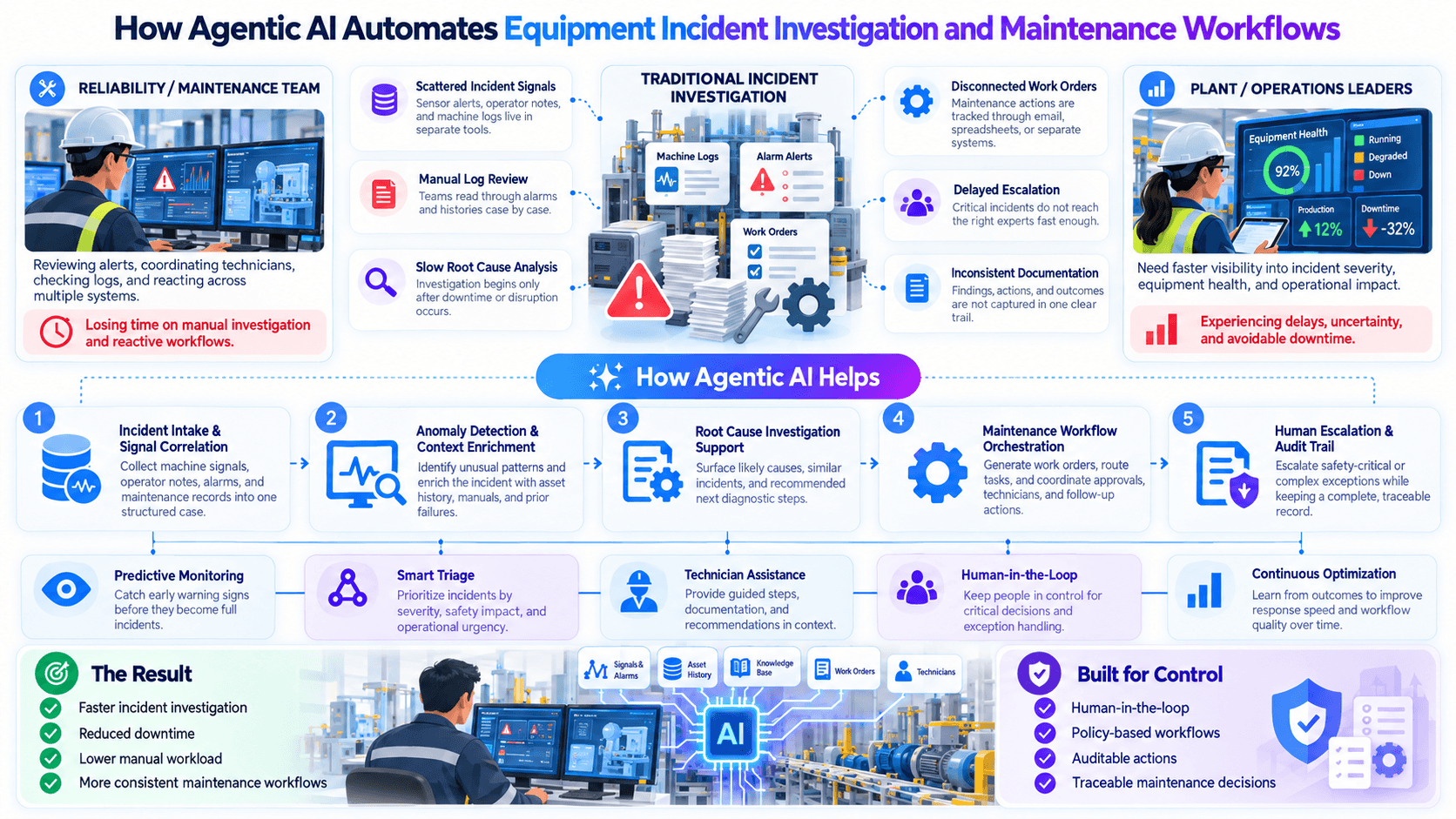
How Agentic AI Automates Equipment Incident Investigation and Maintenance Workflows
Learn how to use agentic AI to investigate equipment incidents, retrieve maintenance knowledge, and coordinate safer repair workflows.
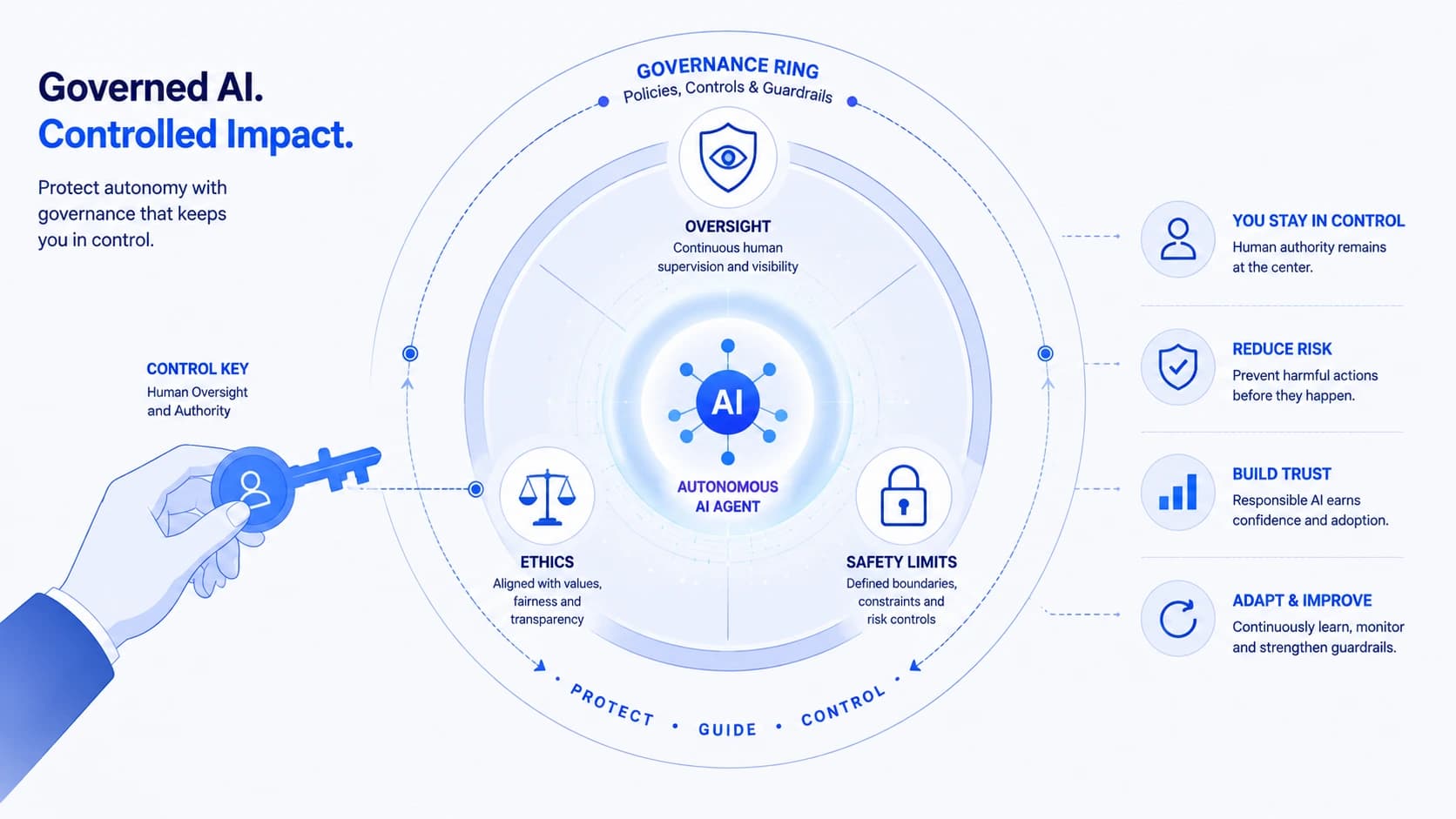
AI Governance for Autonomous Agents: Keeping Control When Software Acts on Its Own
Learn how to govern autonomous AI agents with clear policies, guardrails, and audit trails — so agents stay useful without going off-script.