
AI Agents in Insurance Underwriting: Automating Submission Intake Without Losing Human Control
Learn how AI agents can streamline underwriting intake while preserving human judgment, policy controls, and auditability.
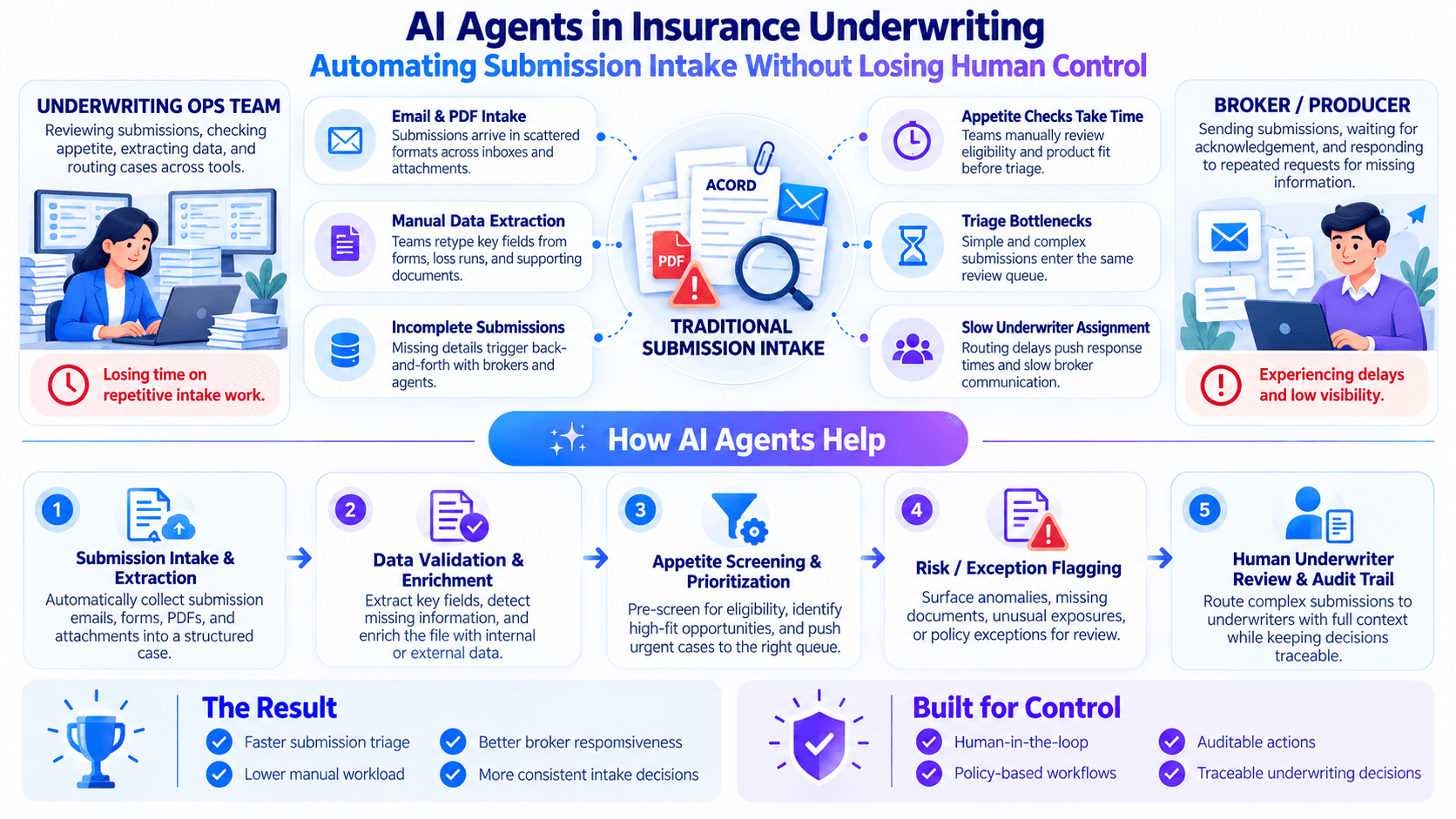
I’ve seen underwriting teams receive a submission that looks simple — until someone opens the attachments.
One document is missing. Another uses a different format. Key details are buried in email. A risk question needs clarification before anyone can move forward.
The underwriter has not even started underwriting yet.
This is where AI agents in insurance underwriting can help most: not by replacing underwriting judgment, but by removing the intake friction that delays it.
Submission Intake Is Still a Hidden Bottleneck
Underwriting is often described as a decision problem.
In practice, a large amount of work happens before a meaningful decision can even begin.
A submission may require teams to:
- collect application documents
- identify what information has been received
- check whether required fields are present
- organize supporting material
- identify missing information
- compare information across documents
- surface inconsistencies
- determine whether the case can proceed
- route exceptions
- prepare the case for an underwriter
- document what happened along the way
None of those steps is the final underwriting decision.
But every one of them can slow the decision down.
The problem becomes worse when submissions arrive in different formats, through different channels, or with different levels of completeness.
Why Traditional Intake Creates So Much Friction
The issue is rarely one broken system.
It is the amount of coordination required between systems, documents, rules, and people.
An experienced underwriter should be applying judgment to risk.
Instead, they may spend time locating documents, reviewing basic completeness, reorganizing information, and chasing missing details.
Some submissions are clean.
Others are incomplete, inconsistent, or difficult to interpret.
The process needs to handle both without forcing every case into the same path.
Different teams may check different requirements at different stages.
That can create rework when a missing requirement is discovered late.
A submission that does not fit the standard process often triggers email threads, internal messages, or manual escalation.
The case moves outside the main workflow.
Ironically, heavily manual processes do not always mean stronger control.
If approvals, exceptions, and overrides happen through scattered communication, it may become harder to reconstruct why a case moved forward.
The better approach is to make human control explicit.
What AI Agents Should — and Should Not — Do
The most useful role for AI agents is not “be the underwriter.”
It is “prepare the underwriter to make a better, faster decision.”
That means agents can be used for tasks such as:
- intake preparation
- document organization
- completeness checks
- information extraction
- case summarization
- exception identification
- workflow routing
- escalation preparation
- policy-based workflow checks
But sensitive decisions should remain within the operating model defined by the insurer.
That may include human review for:
- unusual risks
- incomplete or conflicting information
- exceptions to standard rules
- cases outside delegated authority
- decisions requiring approval
- situations where the workflow cannot reliably proceed
This is where Nuroen AI Human-in-the-Loop can fit naturally: the workflow can pause at defined decision points instead of forcing the agent to continue.
Traditional Underwriting Intake vs. Agent-Assisted Intake
The difference is easier to see when the workflow is compared directly.
| Intake stage | Traditional workflow | Agent-assisted workflow |
|---|---|---|
| Submission received | Human opens email and attachments | Agent prepares the submission for review |
| Document organization | Manual | Agent organizes available information |
| Completeness check | Underwriter or operations team checks manually | Agent checks against defined workflow requirements |
| Missing information | Human identifies and follows up | Workflow routes the case to a missing-information path |
| Policy checks | Reviewed manually at varying stages | Policy rules can be applied at defined workflow points |
| Exception handling | Email or manual escalation | Exception path routes to human review |
| Case preparation | Underwriter assembles summary | Agent prepares structured case context |
| Approval | Informal or separate process | Explicit human approval step |
| Record of actions | Spread across notes and messages | Workflow activity can be captured for audit review |
| Risk judgment | Human | Human where the insurer requires it |
The objective is not “straight-through processing at all costs.”
The objective is to make sure routine intake work does not consume specialist underwriting time.
Build Narrow Agents Instead of One Giant Underwriting Bot
One large agent responsible for everything sounds simple.
Operationally, it can become difficult to govern.
A more controlled design separates responsibilities.
Receives the submission and identifies the available information.
Processes the material and prepares relevant information for downstream steps.
Checks whether the submission contains what is required to proceed.
Evaluates whether the case satisfies defined workflow rules before moving forward.
Identifies situations that need a different route or human review.
Creates a structured summary for the underwriter without making the final underwriting decision.
Handles the decisions and exceptions that should remain under human authority.
Using the Nuroen AI Agent Builder, these responsibilities can be designed as separate agents instead of putting every task into one monolithic workflow.
That makes the architecture easier to reason about.
It also makes it clearer where human control begins and automated assistance ends.
Policy Enforcement Has to Sit Inside the Workflow
Automation becomes risky when policy is treated as a document someone is expected to remember.
A better model is to make policy checks part of the workflow itself.
For example:
Submission received
→ completeness check
→ required information present?
→ if no: stop and request additional information
→ if yes: continue
Then:
Policy check
→ standard path allowed?
→ if yes: prepare for underwriting review
→ if no: route to exception handling
This does not mean every underwriting rule should be converted into autonomous AI decisioning.
It means operational boundaries should be explicit.
Nuroen AI Policy Enforcement can help at this stage by making defined policy controls part of the agent workflow rather than leaving them as informal operating knowledge.
The important question is not:
> Can the AI make this decision?
It is:
> Is the AI allowed to make this decision, under this policy, for this type of case?
Those are very different questions.
Human-in-the-Loop Is Not a Compromise
There is still a tendency to treat human review as a sign that automation has failed.
In underwriting, that is the wrong mindset.
A good system should know when to stop.
For example, a workflow may pause when:
- required information conflicts
- a submission falls outside standard criteria
- an exception is detected
- the case exceeds a defined boundary
- the recommended path needs approval
- an agent cannot confidently complete its assigned task
The agent can prepare the case.
The human decides.
With Nuroen AI Human-in-the-Loop, this handoff can be deliberately designed into the workflow rather than happening through an improvised email or message.
A Concrete Example: Commercial Property Submission
Consider a fictional commercial property insurance submission.
A broker sends:
- an application form
- property details
- occupancy information
- loss-history documents
- supporting material
The submission arrives with most of the required information.
But one supporting document is missing, and the occupancy description in one document does not clearly align with another part of the submission.
An underwriting assistant or underwriter may need to:
- open every attachment
- identify the relevant information
- check which requirements have been satisfied
- identify the missing document
- note the inconsistency
- contact the broker
- update the case
- wait for a response
- reopen the case
- prepare the submission for underwriting review
The underwriter may spend significant effort before evaluating the actual risk.
The Submission Intake Agent receives the case.
The Document Review Agent structures the available information.
The Completeness Agent identifies the missing document.
The workflow stops the normal path and routes the submission to a follow-up step.
Once the missing information arrives, the case resumes.
The Policy Check Agent evaluates the configured workflow conditions.
The inconsistency is routed to an exception path.
A human reviewer receives the structured case context and decides how to proceed.
The agent did not “underwrite the account.”
It prepared the submission so the underwriter could focus on the part that actually requires underwriting judgment.
Auditability Matters as Much as Speed
In insurance, a faster process is useful only if the organization can still explain what happened.
An effective agent-assisted workflow should make it easier to answer questions such as:
- What information did the agent receive?
- Which step ran?
- What rule caused the case to stop?
- Why was the submission escalated?
- Who approved the next action?
- What happened after approval?
- Was a policy exception involved?
This is where Nuroen AI Audit Trails can play an important role.
The goal is not simply to record that “AI was used.”
The useful record is the sequence of workflow actions, human decisions, and policy-driven transitions that explain how the case progressed.
That is much closer to the operating reality insurers need.
Design the Workflow Around Exceptions
Clean submissions make good demos.
Exceptions make good production systems.
Before deploying AI agents in underwriting intake, test cases involving:
- missing documents
- contradictory information
- unexpected formats
- duplicate submissions
- unclear values
- cases outside standard policy
- rejected human approvals
- cases returned for clarification
- incomplete follow-up information
For every exception, define:
- what should stop
- what information should be retained
- who receives the case
- what action is required
- what permits the workflow to resume
- whether approval is required
A workflow that only understands the happy path is not underwriting automation.
It is a prototype.
What Underwriting Leaders Should Define Before Building
Before configuring agents, the business should define the operating boundaries.
A practical checklist includes:
- required information for each submission type
- minimum conditions for a case to proceed
- which checks may be automated
- which decisions remain human
- what counts as an exception
- which exceptions require escalation
- where policy must stop the workflow
- who can approve which path
- what happens after approval or rejection
- what must be recorded for review
- what the agent should do when it cannot determine the next step
This is why successful automation projects start with process design, not prompts.
Step-by-Step: Building an AI-Assisted Underwriting Intake Workflow
A controlled implementation can be built incrementally.
Document the path from submission receipt to underwriter-ready case.
Include every manual handoff, queue, validation step, and approval.
Separate operational tasks from underwriting judgment.
Good early candidates may include:
- submission organization
- completeness checks
- case preparation
- exception routing
Use the Nuroen AI Agent Builder to assign clear responsibilities rather than creating one agent for the entire process.
Each agent should have one understandable job.
Specify when a case may proceed and when it must stop.
Use Policy Enforcement to keep those boundaries inside the workflow.
Identify any case that requires human authorization.
Use Human-in-the-Loop to create explicit pause-and-review stages.
Decide what the organization needs to reconstruct later.
This may include workflow steps, policy outcomes, exceptions, approvals, and final routing.
Use Audit Trails to support that reviewability.
Do not test only complete applications.
Use cases containing:
- missing information
- conflicting values
- policy exceptions
- rejected approvals
- documents that cannot be processed cleanly
Track metrics that show whether the intake process is actually improving.
Useful measures may include:
- submission-to-underwriter time
- active handling time
- number of manual handoffs
- incomplete submission rate
- number of reopened cases
- exception volume
- approval wait time
- rework rate
[BENCHMARK: insert verified pre-automation and post-automation underwriting intake metrics.]
Add more submission types or additional automation only after the initial workflow behaves consistently.
The target should be controlled scale, not maximum autonomy.
What Success Should Look Like
A strong underwriting intake workflow should make the next action obvious.
For any submission, the team should be able to understand:
- what has been received
- what is missing
- what checks have run
- whether an exception exists
- why the case stopped
- who needs to act
- what happens after approval
- what information the underwriter needs to review
The underwriter should receive a better-prepared case.
Operations should spend less time coordinating handoffs.
Leadership should retain control over where automation is allowed to act.
That is a more useful definition of underwriting automation than simply reducing the number of people touching a submission.
Why This Matters
Underwriting depends on judgment.
That is exactly why automation has to be designed carefully.
If AI removes repetitive intake work but makes decisions harder to explain, the insurer has gained speed at the expense of trust.
If AI prepares cases, follows policy boundaries, pauses for human judgment, and leaves a reviewable record, the equation changes.
The goal is not autonomous underwriting for its own sake.
It is giving underwriters cleaner information, clearer exceptions, and more time for the decisions that actually require expertise.
That is where AI agents in insurance underwriting become valuable.
If your team is exploring how to automate submission intake without losing human oversight, Book an Insurance Automation Demo with Nuroen AI.
Placeholders to Complete Before Publishing
- [BENCHMARK: insert verified pre-automation and post-automation underwriting intake metrics.]
Add only verified internal, pilot, customer, or independently sourced performance data.
Optional if available:
- [CUSTOMER STORY: add an approved underwriting automation deployment example.]
Include only if the customer or deployment can be publicly referenced.
Related essays
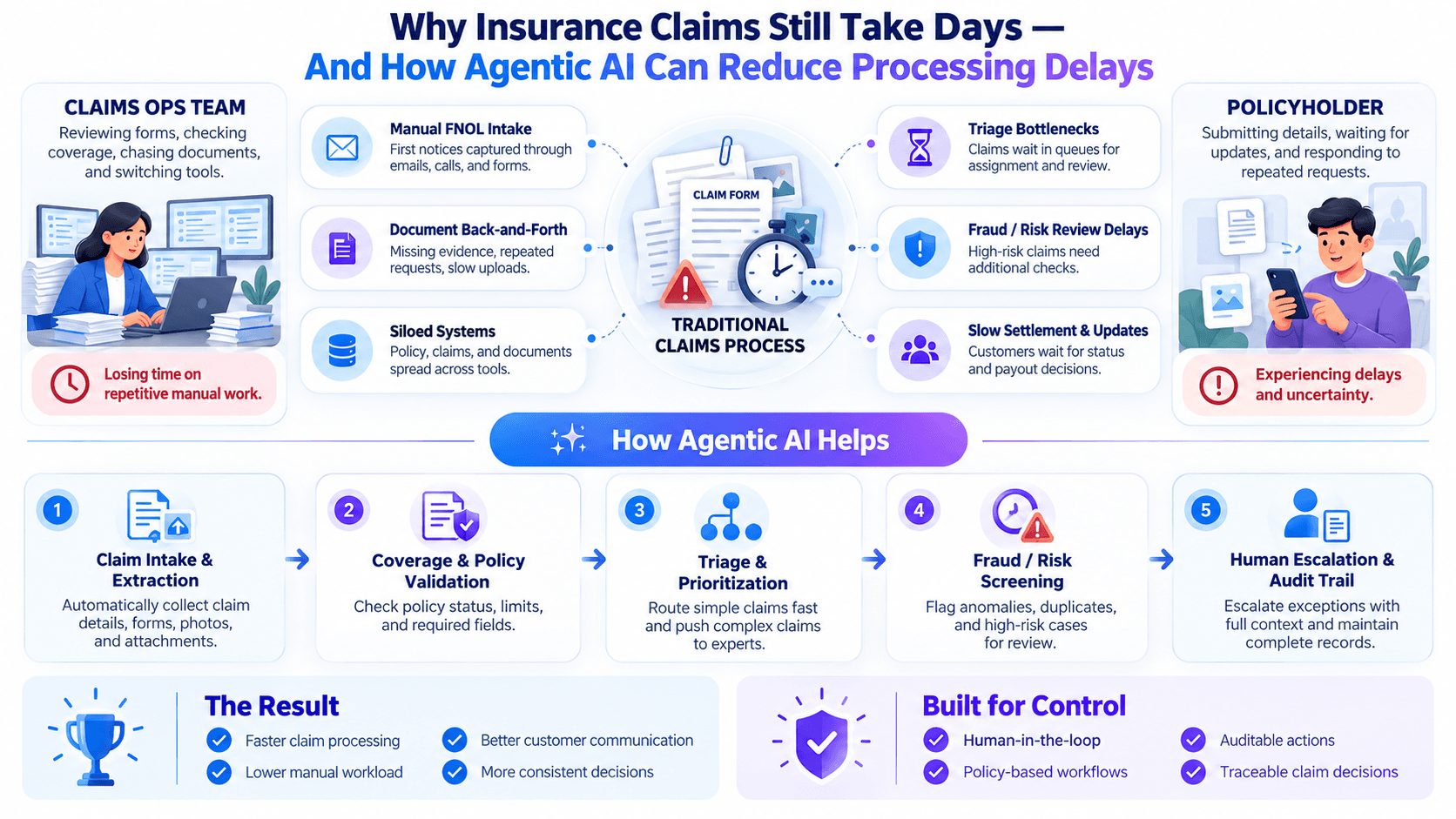
Why Insurance Claims Still Take Days — And How Agentic AI Can Reduce Processing Delays
Learn how agentic AI can reduce claims processing delays by coordinating intake, workflow steps, exceptions, and human approvals.
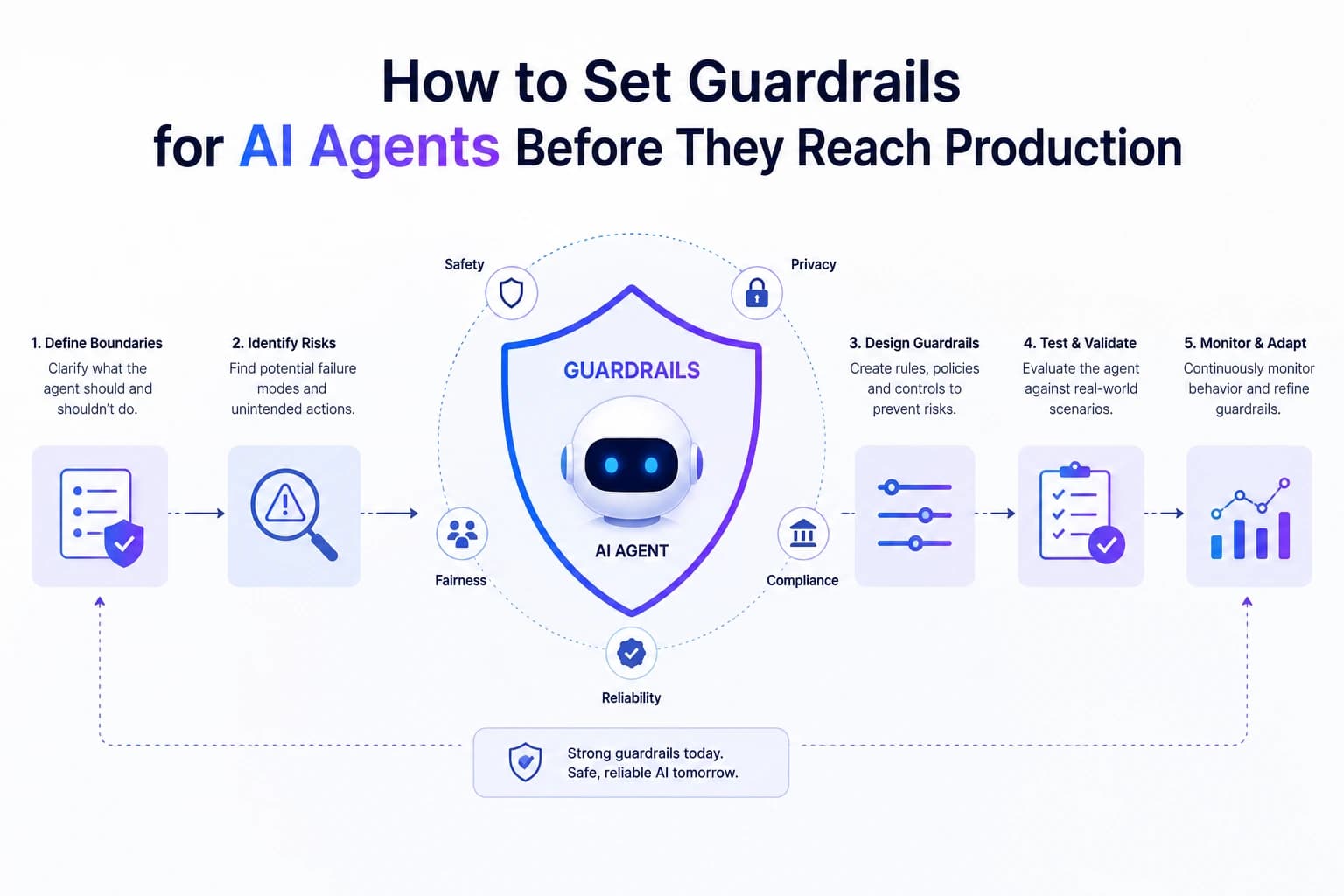
How to Set Guardrails for AI Agents Before They Reach Production
Learn how to set practical guardrails for AI agents — input, action, output, and rate limits — before they touch anything that matters.