
From Document Collection to Risk Assessment: How to Build Automated KYC Workflows with AI Agents
Learn how to build automated KYC workflows with AI agents, multi-agent coordination, approval gates, and controlled human review.
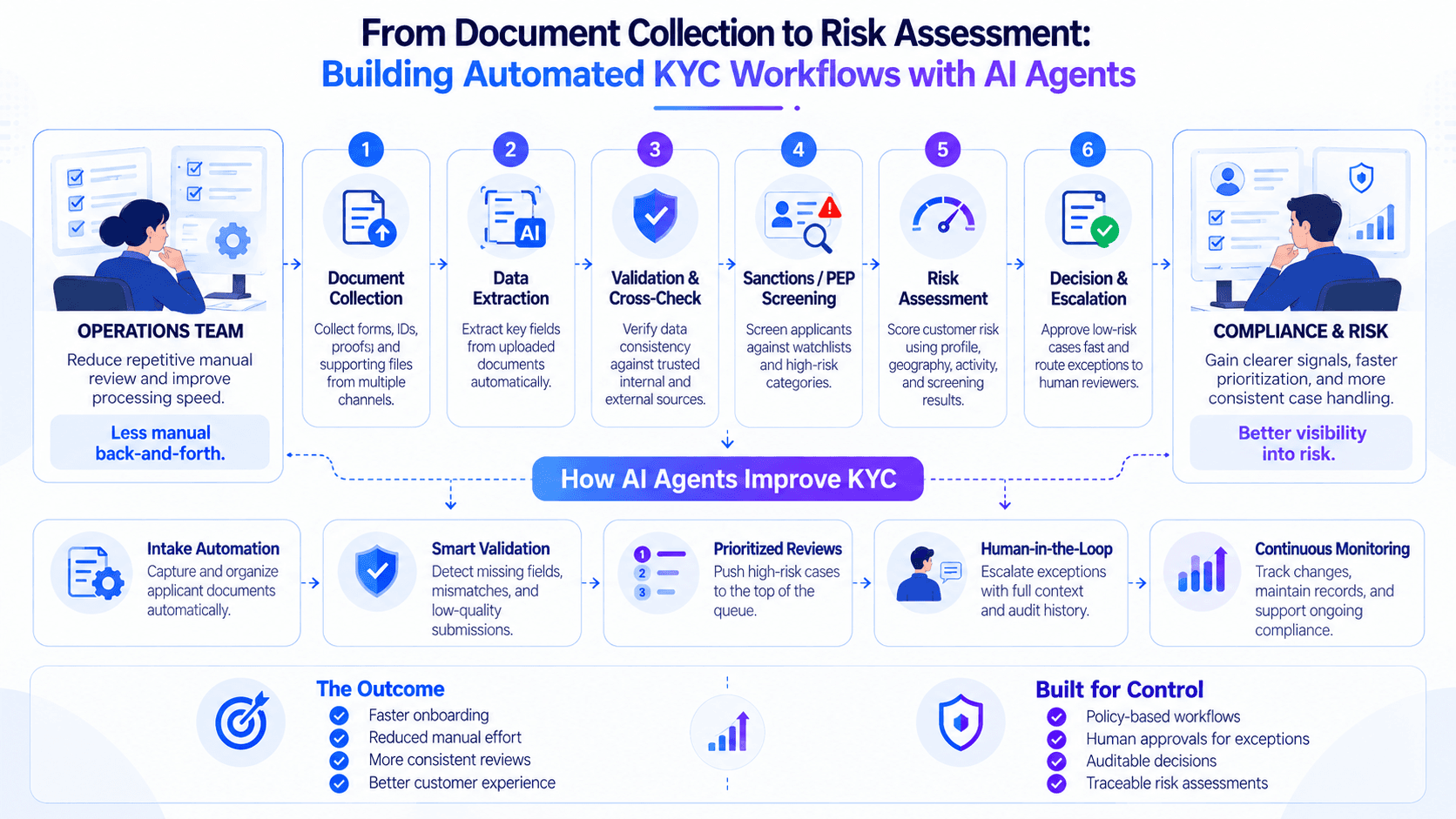
I’ve seen KYC teams lose hours to work that should not require expert judgment.
Documents arrive in different formats. Information gets copied across systems. Analysts chase missing fields. Risk teams reopen the same case because one detail was missed upstream.
The problem is not that KYC lacks process.
The problem is that the process is fragmented.
Automated KYC workflows with AI agents can help close that gap by coordinating document handling, validation, exception routing, risk preparation, and human review as one connected workflow.
KYC Is a Workflow Problem Before It Is an AI Problem
Banks already have procedures for customer onboarding and KYC.
The difficulty is execution.
A single case may require teams to:
- collect identity and business documents
- confirm that required information is present
- extract relevant details
- compare information across documents and systems
- identify inconsistencies
- apply internal review rules
- prepare a risk assessment
- request missing information
- escalate exceptions
- record decisions
- retain supporting evidence
Each step may be manageable on its own.
The operational burden appears between the steps.
A document may be reviewed correctly but not routed quickly. A discrepancy may be identified but not escalated consistently. A case may be ready for review while an analyst is still checking whether all required information has arrived.
That is why automating only one task rarely fixes the end-to-end KYC process.
Why Single-Task Automation Falls Short
Traditional automation often targets one narrow action.
For example:
- extract text from a document
- classify a form
- send a reminder
- populate a field
- generate a summary
Those actions can save time.
But they do not necessarily reduce coordination.
If a human still has to decide what happens after every automated step, the workflow remains human-orchestrated.
The real opportunity is to connect those steps.
Instead of:
Document extraction → human checks result → human opens another system → human routes case
the workflow can become:
Document intake → AI review → validation → exception check → risk preparation → approval gate → next action
This is where multi-agent workflows become useful.
What an Automated KYC Workflow Actually Needs
A production-ready KYC workflow needs more than a single AI prompt.
It needs distinct responsibilities.
A well-designed architecture could include:
Receives the case and determines what information and documents are available.
Its job is not to assess risk.
Its job is to establish the starting state of the case.
Processes incoming documents and prepares structured information for downstream review.
Checks whether required information is available before the case moves forward.
If something is missing, the workflow should stop progressing and trigger the appropriate follow-up path.
Compares information across available records and identifies inconsistencies that need review.
Organizes the information required for a risk assessment and prepares a structured summary for the next decision point.
Handles cases that do not fit the expected path.
Examples include:
- conflicting information
- incomplete ownership details
- unclear documentation
- unexpected data
- cases requiring additional review
Owns the decisions that policy or risk teams do not want delegated to automation.
Coordinates all of the above.
It determines which agent runs next, what information is passed forward, when a case should pause, and when a human approval is required.
With Nuroen AI multi-agent workflows, this kind of process can be designed as a set of specialized responsibilities rather than one oversized agent trying to handle the full KYC lifecycle.
Manual KYC vs. Multi-Agent KYC
The distinction is easier to see side by side.
| Workflow stage | Traditional KYC process | Multi-agent KYC workflow |
|---|---|---|
| Document intake | Analyst locates and organizes files | Intake workflow prepares the case |
| Document processing | Analyst reads and extracts information manually | Document-processing agent structures relevant information |
| Completeness check | Analyst checks required fields and files | Dedicated agent checks whether the case can proceed |
| Validation | Analyst compares information across sources | Validation agent flags inconsistencies |
| Risk preparation | Analyst assembles evidence and summary | Risk agent prepares a structured review package |
| Exception handling | Depends heavily on analyst judgment and handoffs | Exception path routes unusual cases for review |
| System handoffs | Often manual | Enterprise connectors can support controlled movement between systems |
| Decision point | Human reviewer | Human reviewer where policy requires it |
| Approval | Email, ticket, or manual sign-off | Explicit approval gate in the workflow |
| Follow-up | Analyst reopens and continues the case | Workflow resumes after the required action or approval |
The goal is not to remove humans from KYC.
It is to remove unnecessary human coordination.
The Role of Enterprise Connectors
KYC rarely happens inside one application.
The workflow may depend on customer data, document repositories, case-management systems, internal records, or other enterprise applications.
That creates a practical problem.
Even the best reasoning agent is limited if a human still has to manually move every piece of information between systems.
This is where Nuroen AI enterprise connectors can help at the workflow level.
The useful pattern is not simply “connect more tools.”
It is:
- retrieve the information needed for the current step
- pass only the required context into the workflow
- perform the defined task
- route the result to the next stage
- pause when human approval is required
The connector is part of the workflow, not the workflow itself.
That distinction matters because automation should follow the bank's process rather than forcing the process to follow individual tools.
Approval Gates Are a Feature, Not a Failure
There is a temptation in automation projects to measure success by how few human interactions remain.
That is the wrong goal for KYC.
Some decisions should be deliberately difficult to automate.
Examples may include:
- accepting a material exception
- approving a high-risk case
- proceeding despite conflicting information
- overriding a standard review path
- taking an action that internal policy reserves for a human
An approval gate makes that boundary explicit.
The agent can prepare the case, organize evidence, explain the exception, and recommend a next step.
The reviewer decides.
With Nuroen AI approval gates, teams can design these human checkpoints into the workflow instead of relying on informal escalation outside the automation.
That creates a clearer operating model:
Agent prepares → workflow pauses → human reviews → approved or rejected → workflow continues
A Concrete Example: Onboarding a Mid-Market Business Customer
Consider a common commercial-banking onboarding scenario.
A mid-market manufacturing company submits its KYC package.
The case includes:
- company-registration documents
- director details
- beneficial-owner information
- proof-of-address documentation
- onboarding forms
The bank needs to determine whether the case is complete and ready for risk review.
An analyst may need to:
- download the documents
- open each file
- compare names and addresses
- confirm ownership information
- check whether required fields are present
- identify a missing supporting document
- draft a follow-up
- update the case status
- reopen the case when the document arrives
- prepare a summary for risk review
That work may involve several systems and multiple handoffs.
The workflow could instead operate like this:
Intake Agent Determines which documents and information have arrived.
Document Processing Agent Structures relevant information from the submitted package.
Completeness Agent Finds that one required item is missing.
Workflow Orchestrator Stops the normal risk path and routes the case to the missing-information branch.
Follow-up step The appropriate request is prepared.
Once the required information arrives:
Validation Agent Checks for inconsistencies across the available records.
Risk Preparation Agent Builds a structured summary for review.
Approval Gate The case pauses if the configured workflow requires human sign-off.
The value is not that AI “does KYC.”
The value is that the case moves through a consistent sequence without requiring an analyst to coordinate every transition manually.
Design the Workflow Around Exceptions
Happy-path automation is easy to demonstrate.
Real KYC operations are defined by exceptions.
A useful workflow should explicitly plan for cases such as:
- required documents missing
- duplicate submissions
- information that cannot be confidently interpreted
- names or addresses that do not align
- ownership information that needs clarification
- documents that cannot be processed cleanly
- cases that trigger an internal review rule
- a human rejecting an agent-prepared recommendation
For each exception, define:
- what should stop
- what information should be preserved
- which agent or person receives the case
- what additional information is needed
- what event allows the workflow to resume
This is one reason multi-agent design can be more manageable than one large autonomous agent.
Each agent can have a narrower responsibility and a clearer failure path.
Keep Risk Assessment Separate From Data Collection
One of the most important design choices is separating information gathering from risk judgment.
Those are different tasks.
Information gathering asks:
- Do we have the required documents?
- What information is contained in them?
- Does the case contain conflicting information?
- What information still needs to be collected?
Risk assessment asks:
- What does this information mean under the bank's review framework?
- Does the case require escalation?
- Can the case proceed?
- Who is authorized to approve it?
Mixing these stages makes the workflow harder to govern.
Keeping them separate creates cleaner accountability.
For example:
Collection Agent → Validation Agent → Risk Preparation Agent → Approval Gate
Rather than:
One AI agent → final decision
Nuroen AI's multi-agent workflow model and approval gates naturally fit this separation of responsibilities.
What Banking Teams Should Define Before Building
Before automating the process, document the rules of the process.
At minimum, define:
- required information for each customer type
- minimum conditions for a case to proceed
- what constitutes an exception
- which exceptions require human review
- which workflow steps may run automatically
- what information each agent is allowed to use
- what information must be passed between stages
- what action follows each possible outcome
- who owns final approval
- what happens when an agent cannot confidently complete its task
The strongest implementation starts with clear operating rules.
AI comes second.
Step-by-Step: Building an Automated KYC Workflow with AI Agents
A practical implementation can be built in stages.
Start from document submission and follow the case through to final review.
Identify every handoff, decision, and manual check.
Mark which activities are operational and which involve meaningful judgment.
Operational work is often the safest place to begin.
Assign one clear responsibility to each agent.
For example:
- intake
- document processing
- completeness
- validation
- risk preparation
- exception handling
Determine which systems each stage needs to read from or pass information to.
This is where Nuroen AI enterprise connectors can support controlled movement of information between workflow stages.
Do not connect systems simply because they are available.
Connect them because a specific workflow step requires them.
Define what happens after every major outcome.
For example:
Complete → validation
Incomplete → request additional information
Conflict detected → exception review
Ready for decision → approval gate
Identify steps where the workflow must pause for a human decision.
These should be explicit rather than handled informally through email or side conversations.
Do not test only clean submissions.
Test:
- missing documents
- conflicting fields
- unreadable files
- incomplete ownership information
- unexpected case types
- rejected approvals
- cases that need to be returned for rework
Track operational measures that show whether the process is improving.
Potential measures include:
- average handling time
- total KYC turnaround time
- number of manual handoffs
- number of reopened cases
- percentage of cases requiring additional information
- exception rate
- approval wait time
- rework volume
[BENCHMARK: insert verified pre-automation and post-automation KYC workflow metrics.]
Once the workflow is predictable, extend automation into additional case types or stages.
Do not increase autonomy faster than the organization can govern it.
What Success Should Look Like
The best outcome is not a KYC department with no people.
It is a KYC operation where people spend less time moving information and more time applying judgment.
A successful workflow should make it easier to answer:
- What stage is this case in?
- Why did it stop?
- What information is missing?
- What exception was detected?
- Who needs to approve the next step?
- What happens after approval?
- What evidence supports the case summary?
If those questions remain difficult to answer, automation has probably added complexity rather than removed it.
Why This Matters
KYC is ultimately about trust.
Banks need confidence that the customer information they rely on has been collected, reviewed, escalated, and approved through a defensible process.
Customers need confidence that onboarding will not disappear into a maze of repeated document requests and manual handoffs.
AI agents can help reconcile those two needs.
Not by replacing control, but by making control part of the workflow.
That is the bigger opportunity behind automated KYC workflows with AI agents: faster operations without treating governance as an afterthought.
For banking operations, risk, and automation teams exploring this model, book a demo of Nuroen AI to see how multi-agent workflows, enterprise connectors, and approval gates can be applied to a controlled KYC process.
Placeholders to Complete Before Publishing
- [BENCHMARK: insert verified pre-automation and post-automation KYC workflow metrics.]
Add only verified internal, pilot, customer, or independently sourced performance data.
Optional if available:
- [CUSTOMER STORY: add an approved banking or fintech KYC deployment example.]
Use only if the customer reference is approved for public use.
Related essays
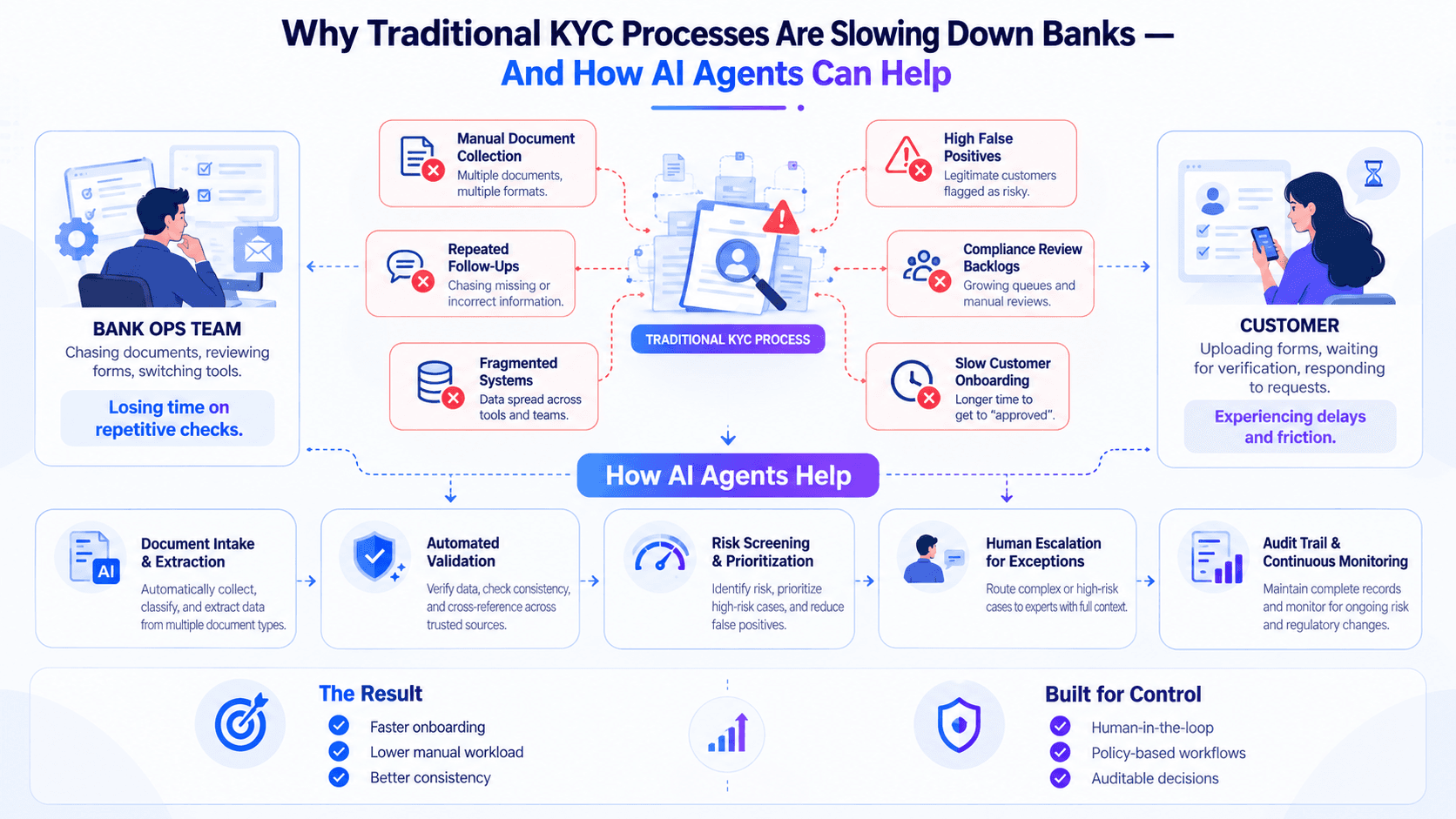
Why Traditional KYC Processes Are Failing Banks — And How AI Agents Can Fix Them
Learn how AI agents can reduce manual KYC work, orchestrate document reviews, and keep compliance decisions under human control.
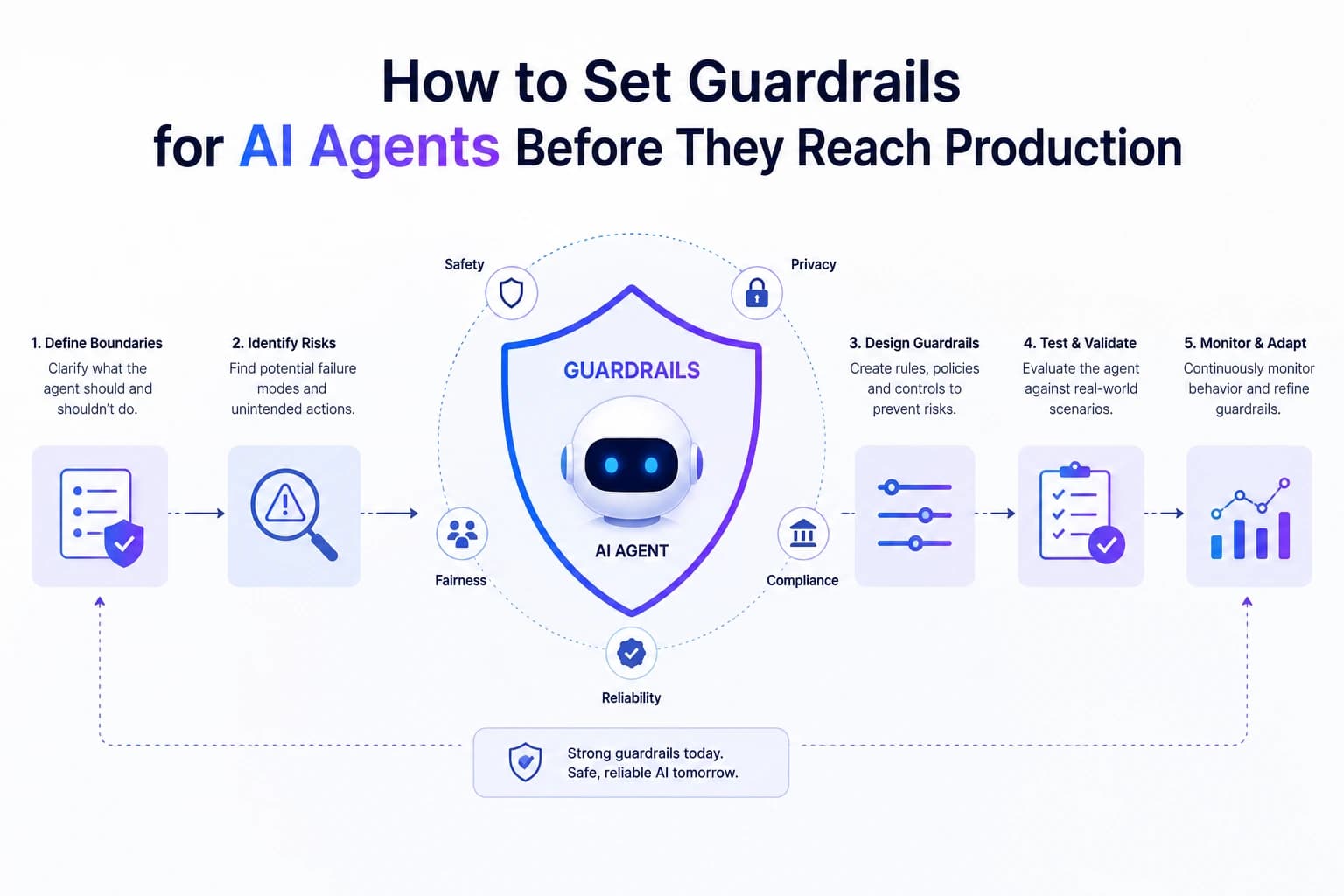
How to Set Guardrails for AI Agents Before They Reach Production
Learn how to set practical guardrails for AI agents — input, action, output, and rate limits — before they touch anything that matters.