
Why Traditional KYC Processes Are Failing Banks — And How AI Agents Can Fix Them
Learn how AI agents can reduce manual KYC work, orchestrate document reviews, and keep compliance decisions under human control.
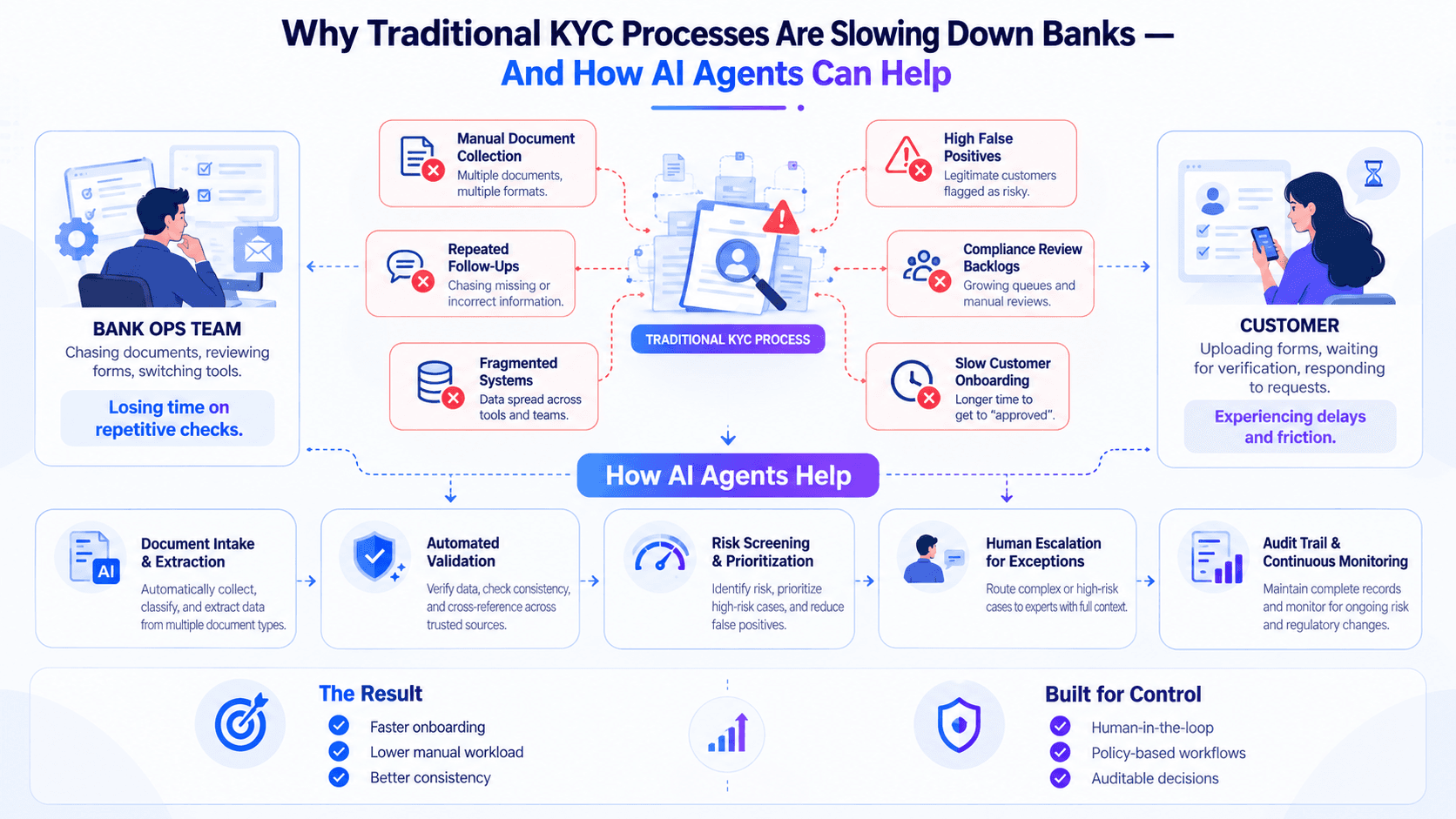
I’ve seen the same KYC problem show up in different forms.
A customer submits documents. One team checks them. Another team asks for missing information. A compliance analyst rechecks the same case. Someone updates a tracker. Someone else follows up by email.
And days later, the customer is still waiting.
The problem is not that banks lack systems.
The problem is that too much of the KYC process still depends on humans moving information between those systems.
That is where AI agents can change the operating model.
Not by removing compliance teams from the process, but by taking over the repetitive investigation, document handling, coordination, and case preparation that consumes their time.
Traditional KYC Processes Were Not Designed for Today's Operating Environment
Traditional KYC processes often grew organically.
A bank might have one system for onboarding, another for document storage, another for customer information, another for compliance reviews, and spreadsheets or email sitting between them.
Each individual tool may work.
The workflow between them is where friction appears.
A typical KYC case can involve:
- collecting identity and business documents
- checking whether required information is present
- reviewing submitted documents
- comparing information across systems
- identifying inconsistencies
- requesting additional information
- applying internal KYC policies
- escalating higher-risk cases
- documenting the decision
- maintaining evidence for future review
The more complex the customer, the more complicated the workflow becomes.
For corporate customers, beneficial ownership structures, multiple directors, jurisdictional differences, and additional evidence requirements can make a single case significantly harder to manage.
Where Traditional KYC Processes Start Breaking Down
The biggest issue is rarely one catastrophic failure.
It is accumulated operational friction.
Compliance teams spend significant time checking whether documents exist, whether required fields are present, and whether information is consistent across submissions.
That work matters.
But much of the initial review is procedural rather than judgment-heavy.
Information is often copied between documents, case-management systems, internal databases, spreadsheets, and emails.
Every additional handoff introduces another opportunity for delay or inconsistency.
An analyst may need to move across multiple systems just to understand one customer.
The investigation becomes less about making a compliance decision and more about collecting enough information to make one.
Different analysts may handle similar exceptions differently unless escalation rules are consistently embedded into the workflow.
From the customer's perspective, none of this complexity matters.
They simply see another request:
> "Please provide the following document."
Sometimes for information they believe they have already supplied.
That is where operational inefficiency becomes a customer-experience problem.
Traditional KYC vs. Agent-Orchestrated KYC
The difference is not simply "manual versus AI."
A better comparison is human-coordinated workflow versus machine-orchestrated workflow with human control.
| KYC activity | Traditional approach | Agent-orchestrated approach |
|---|---|---|
| Document intake | Humans locate and organize submissions | AI workflow processes incoming documents and prepares the case |
| Completeness checks | Analyst manually checks requirements | Agent evaluates whether required information is available |
| Information comparison | Analyst moves between documents and systems | Agent prepares relevant information for comparison |
| Missing information | Analyst identifies gaps and drafts requests | Agent identifies gaps and prepares the next action |
| Policy application | Analyst manually references procedures | Agent can guide workflow according to defined instructions |
| Exception handling | Analyst decides when to escalate | Exceptions are routed to appropriate human review |
| Case preparation | Analyst manually creates case summary | Agent prepares a structured review package |
| Final judgment | Human | Human where governance requires it |
| Audit trail | Distributed across systems and notes | Workflow can be structured around clearly defined decision steps |
The objective is not to automate judgment blindly.
It is to automate the work surrounding judgment.
The Better Model: Agents Prepare Decisions, Humans Own Sensitive Decisions
This distinction matters.
KYC is not an ideal environment for uncontrolled automation.
There are edge cases.
Documents conflict.
Customer structures can be complicated.
Policies evolve.
And some decisions carry significant regulatory and reputational consequences.
An agentic KYC workflow therefore needs clear boundaries.
AI agents can handle activities such as:
- organizing information
- processing submitted documents
- identifying missing information
- preparing case summaries
- coordinating workflow steps
- routing exceptions
- preparing recommended next actions
Human reviewers remain involved where policy or risk requires judgment.
This is where Human-in-the-Loop Governance in Nuroen AI becomes relevant.
Instead of designing an agent that simply attempts to complete an entire KYC process autonomously, teams can design workflows where sensitive decisions deliberately return to a person.
The automation handles the operational burden.
The human retains authority.
What Multi-Agent KYC Could Look Like
A complex KYC workflow does not necessarily need one enormous AI agent.
It can be broken into specialized responsibilities.
For example:
Receives the case and determines what information has been supplied.
Processes the submitted KYC documentation and prepares relevant information for downstream review.
Checks whether the case contains the information required for the next stage.
Organizes customer information into a consistent case summary.
Identifies situations that require further investigation or human review.
Prepares requests for missing information or other customer communication.
Coordinates the sequence, passes relevant context between agents, and determines which workflow should run next.
This is where Nuroen AI's agent orchestration can fit into the architecture.
Instead of treating KYC as one monolithic prompt, the workflow can be decomposed into specific responsibilities with defined transitions and review points.
A Concrete Example: Business Customer Onboarding
Consider a fictional example.
A small manufacturing company applies for a new business banking relationship.
It submits:
- company registration documentation
- director information
- beneficial-owner information
- address documentation
- additional onboarding information requested by the bank
During review, one required piece of information is missing.
At the same time, information in one submitted document does not clearly match another part of the application.
In a traditional workflow, an analyst might:
- open each document
- compare the information manually
- check the onboarding record
- identify the missing item
- document the discrepancy
- draft a follow-up
- update the case
- wait for the response
- reopen the case later
An agent-assisted workflow could instead prepare that investigation before the analyst becomes involved.
The system can process the documents, identify that the case is incomplete, structure the discrepancy, and route the case appropriately.
The analyst receives something closer to:
Case status: Additional review required
Missing information: [required information]
Observed discrepancy: [structured explanation]
Recommended next step: Request clarification and missing documentation
The analyst can then review the evidence and decide whether the proposed next step is appropriate.
That is a much better use of specialist compliance time.
Document Processing Is Only One Part of the Problem
It is tempting to frame KYC automation primarily as document extraction.
But extracting information from documents is only one step.
The real workflow is closer to:
Receive → Process → Validate → Compare → Investigate → Decide → Escalate → Communicate → Record
Automating document processing without orchestrating what happens afterward still leaves analysts coordinating the workflow manually.
This is why combining document processing with agent orchestration in Nuroen AI is more useful than treating document processing as an isolated capability.
The document becomes an input to a larger business process.
Governance Has to Be Designed Into the Workflow
Banks should be cautious about any KYC architecture that starts with:
> "Let the AI handle everything."
A better design begins by defining what the AI is allowed to do.
Before deploying an agentic KYC workflow, teams should establish:
- which actions agents may perform independently
- which cases require human review
- what information agents are allowed to process
- what conditions trigger escalation
- which decisions must always remain human
- how exceptions are handled
- how workflow activity is reviewed
- how changes to agent behaviour are governed
The most valuable automation is not necessarily the workflow with the fewest humans.
It is the workflow with the right humans involved at the right points.
Nuroen AI's Human-in-the-Loop Governance is relevant here because approval and review points can remain part of the operating model rather than being treated as failures of automation.
How to Design an Agentic KYC Workflow
A practical implementation can start small.
Document every major step from customer submission to final review.
Separate actual compliance decisions from administrative work.
Look for activities such as document organization, completeness checks, case preparation, information comparison, and follow-up preparation.
These are often better initial automation targets than final decision-making.
Avoid creating one agent responsible for everything.
Give each agent a narrow, understandable role.
For example:
- document processing
- completeness checking
- case summarization
- exception routing
- communication preparation
Specify what happens after each result.
For example:
Documents received
→ Document Processing Agent
→ Completeness Check
→ Complete?
→ Yes → Review workflow
→ No → Missing-information workflow
→ Exception detected?
→ Yes → Human review
Identify decisions where compliance personnel need to remain involved.
These checkpoints should be part of the design from the beginning.
Do not test only perfect applications.
Test scenarios involving:
- missing documents
- contradictory information
- unusual ownership structures
- unclear information
- duplicate submissions
- unexpected document formats
- cases requiring escalation
Once the initial workflow behaves consistently, additional steps can be automated.
Nuroen AI can support this model through agent orchestration, document processing, and human-in-the-loop governance without requiring the organization to treat the entire KYC process as one autonomous decision.
How Banks Should Measure Whether It Is Working
The goal should not simply be "more AI."
Measure operational outcomes.
Useful measures may include:
- KYC processing time
- analyst handling time
- number of manual handoffs
- percentage of incomplete cases
- frequency of customer follow-ups
- exception volumes
- human-review rates
- rework rates
[BENCHMARK: insert your verified baseline and post-implementation KYC processing or analyst-efficiency data here.]
A useful question is:
> Are compliance specialists spending more of their time making meaningful decisions and less of their time assembling cases?
If the answer is yes, automation is doing something valuable.
Why This Matters
KYC sits at an uncomfortable intersection.
Banks need to move quickly enough to deliver a good customer experience, but carefully enough to protect themselves from financial crime, regulatory exposure, and poor decisions.
That tension is not going away.
AI agents offer an opportunity to rethink the operating model — not by removing accountability, but by reducing the manual coordination surrounding it.
The strongest KYC systems will likely be those where machines handle more of the repetitive investigation and workflow preparation while humans retain control over the decisions that carry real consequences.
That is ultimately a question of trust.
And in banking, trust matters more than automation for automation's sake.
If your team is exploring how agent orchestration, document processing, and human-in-the-loop governance could fit into your KYC operations, book a demo of Nuroen AI to explore the workflow with your team.
Placeholders to complete before publishing
- [BENCHMARK: insert your verified baseline and post-implementation KYC processing or analyst-efficiency data here.]
- [CUSTOMER STORY: add a verified banking/fintech KYC example if one becomes available.]
Related essays
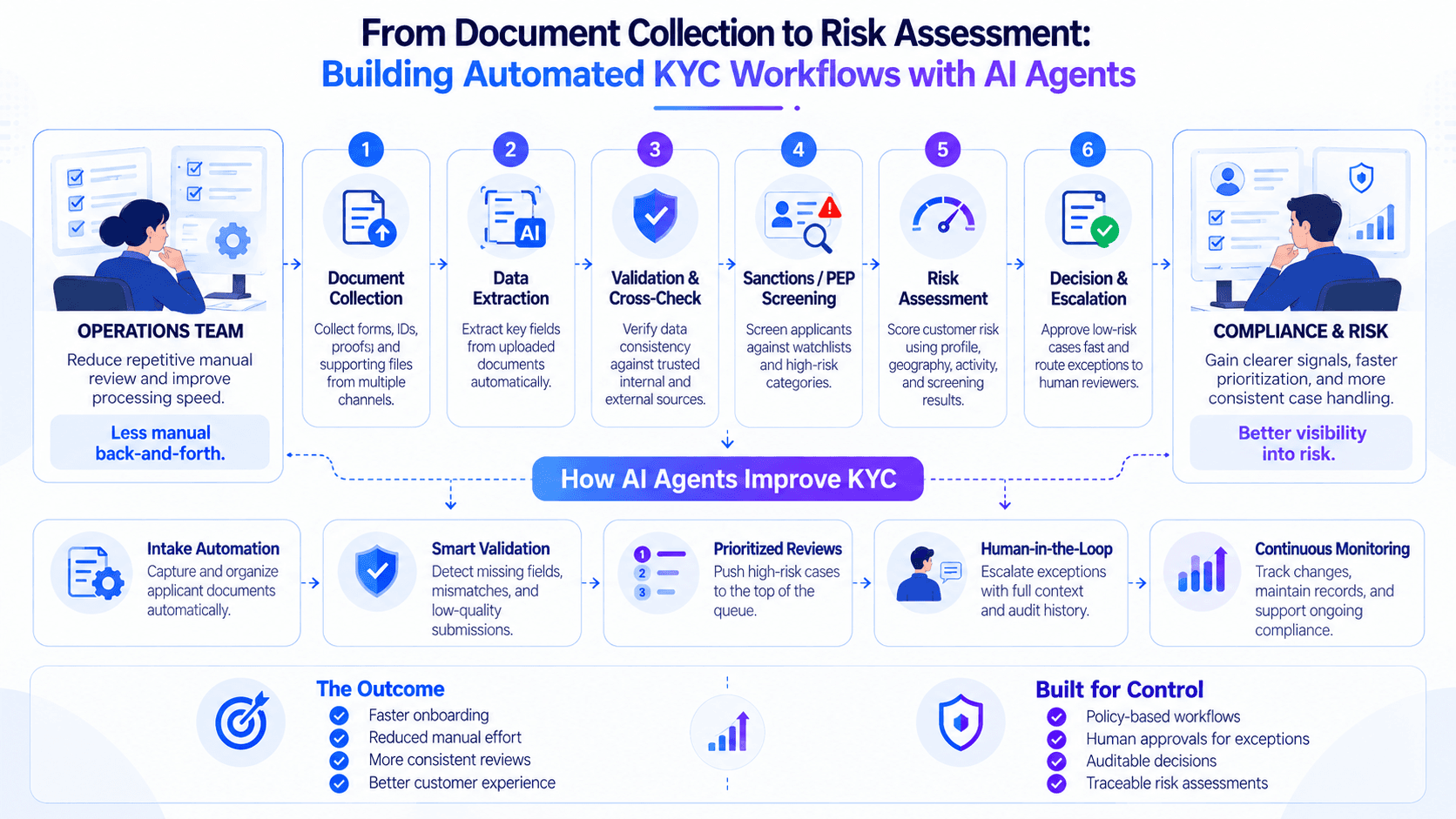
From Document Collection to Risk Assessment: How to Build Automated KYC Workflows with AI Agents
Learn how to build automated KYC workflows with AI agents, multi-agent coordination, approval gates, and controlled human review.
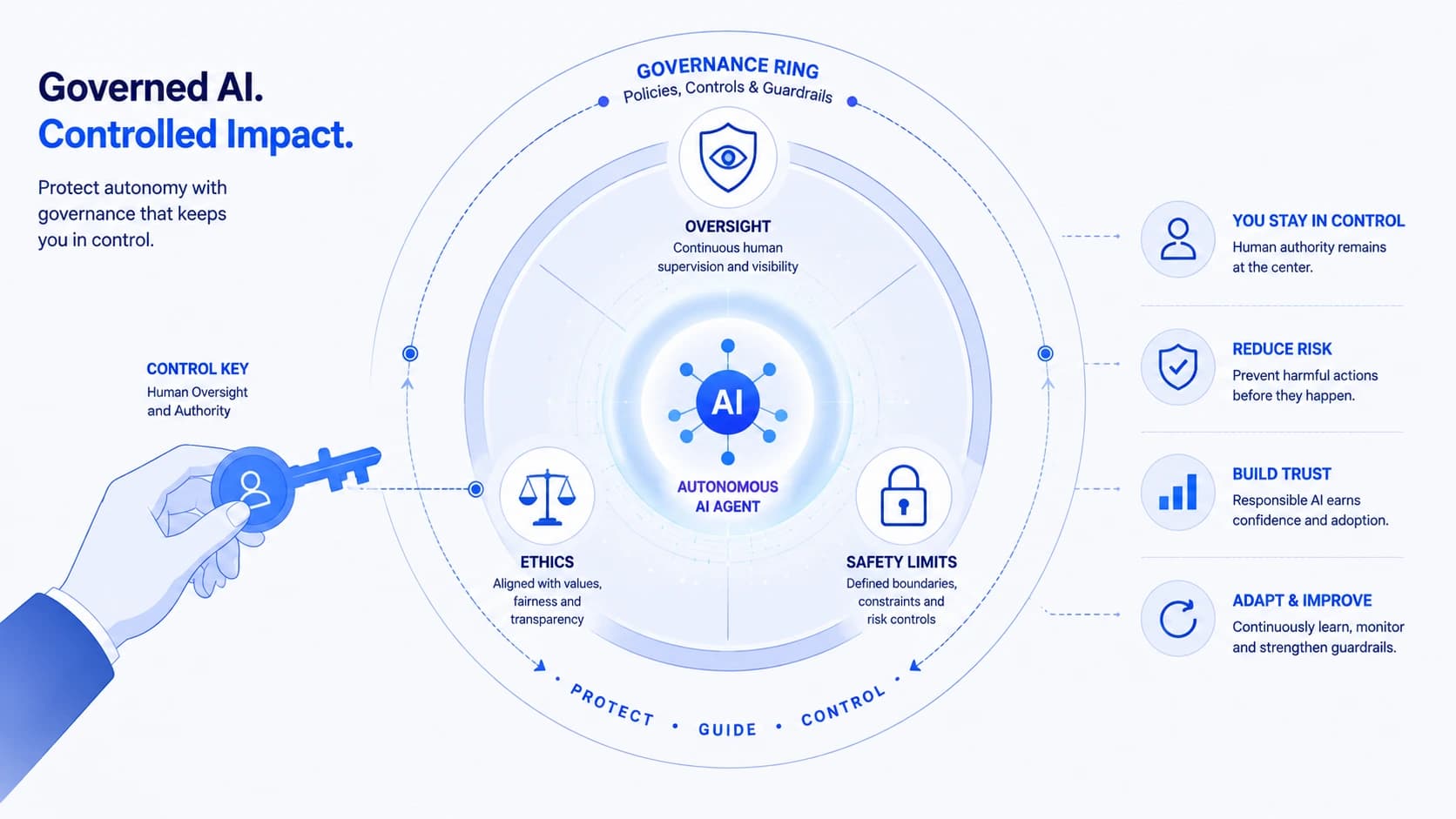
AI Governance for Autonomous Agents: Keeping Control When Software Acts on Its Own
Learn how to govern autonomous AI agents with clear policies, guardrails, and audit trails — so agents stay useful without going off-script.