
Who's Accountable When an Autonomous Agent Makes a Mistake?
Learn how to assign accountability for autonomous AI agents before something goes wrong — and why "the AI did it" is never an answer.
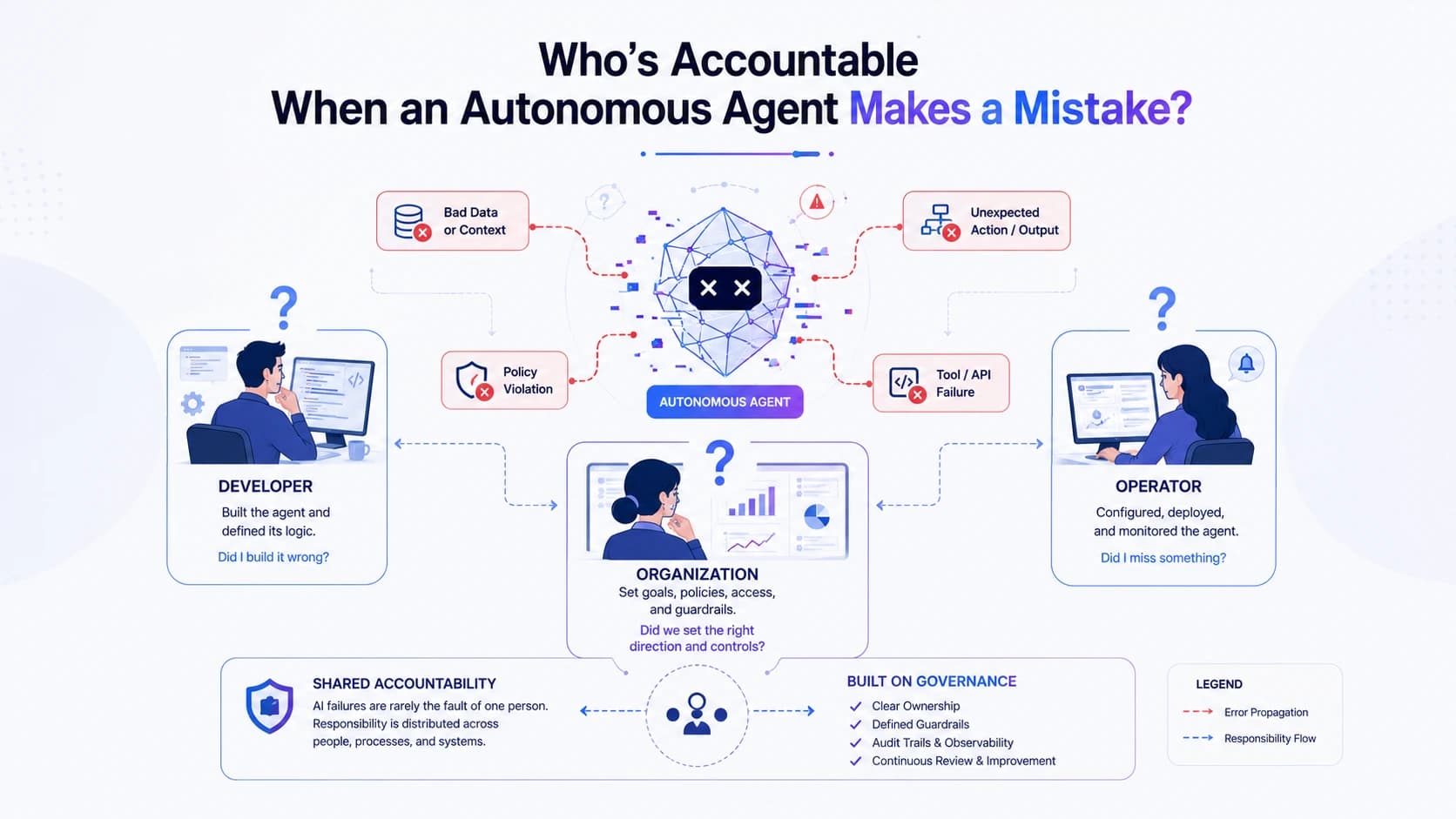
An agent sends a wrong quote to a customer. The customer holds you to it. Who's responsible?
"The AI did it" is not going to survive that conversation — not with the customer, not with a regulator, not with your own leadership.
This is the question every team deploying agents eventually has to answer. Better to answer it before the incident than during it.
"The Agent Did It" Isn't an Answer
An autonomous agent isn't a legal person. It can't be held responsible, can't be sued, can't sign off on a decision. Accountability always lands on a human somewhere in the chain.
The only real question is which human — and whether you decided that on purpose or by default. If you didn't decide, the failure decides for you, usually by landing on whoever's closest.
The People in the Chain
When an agent acts, several parties had a hand in it. Accountability usually maps to who controlled the relevant decision.
| Party | What they controlled | On the hook when… |
|---|---|---|
| Operator | Ran the agent, gave it the task | The instruction or context was wrong |
| Builder / team | Designed the agent and its limits | A needed guardrail was missing |
| Reviewer | Approved a checkpoint | They waved through a bad action |
| Organization | Chose to deploy at all | There was no governance in place |
The uncomfortable one is the last row. If an agent causes harm and there were no controls, accountability tends to roll straight up to the organization — because deploying an ungoverned agent was itself the decision.
Why Agents Blur the Line
With traditional software, a bug traces to a line of code and a person who wrote it. Agents scramble that clean line.
- The agent took a path no one explicitly wrote.
- The instruction was vague, and the agent filled the gap.
- Several tool calls chained into an outcome no single step intended.
None of that removes accountability. It just makes it harder to locate after the fact — which is exactly why you assign it in advance.
A Concrete Example
An agent gives a customer incorrect advice that costs them money. They come back to you.
Walk the chain:
- Was there a policy saying the agent shouldn't advise on this? If not — that's on the builders and the org.
- Was there a guardrail to block it? If not — same.
- Did a human approve the response at a checkpoint? If so — the reviewer shares it.
- Is there a log of what the agent actually did? If not — now no one can even locate responsibility, which is its own failure.
The accountability was decided long before the mistake — by which controls existed. That's the real insight: governance is how you assign accountability ahead of time.
Assigning Accountability Up Front — A Workflow
Do this before the agent goes live, not after the incident:
- Name an owner for the agent. One person accountable for its behavior in production. Not a committee.
- Write policies that state intent. What it may and may not do, in plain language. This defines what "a mistake" even is.
- Attach a control to each high-stakes action. A guardrail or a human checkpoint. Whoever approves a checkpoint is knowingly accepting that share.
- Log everything. Without a record, accountability is unassignable — you can't hold anyone responsible for an action no one can reconstruct.
- Write the escalation path. When something goes wrong, who's told, who decides, who communicates. Decide it cold, not in the heat.
A governance layer like Nuroen is meant to make this traceable by default — tying every action to a policy, a checkpoint, and a log, so "who's accountable" has an answer on record.
Why This Matters
Someone is accountable for every autonomous agent you run. The only variable is whether you chose who, or let an incident choose for you.
Teams that decide this in advance can move faster, because they know exactly who owns what. Teams that don't discover the answer at the worst possible time — usually with a customer, a lawyer, or a regulator in the room.
This is a general discussion of how teams think about accountability, not legal advice — for your specific obligations, talk to counsel.
Related essays
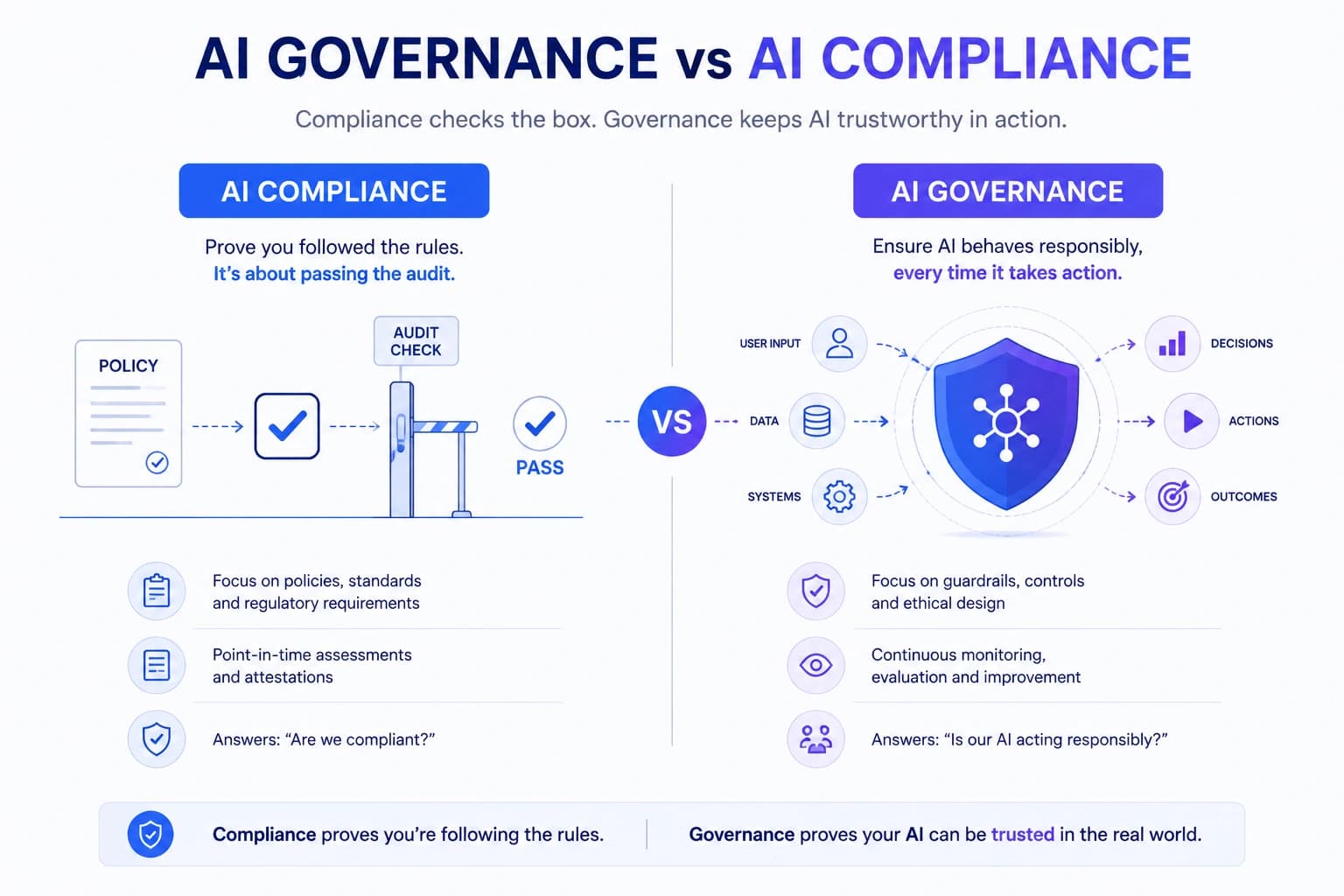
AI Governance vs. Compliance: Why Passing the Audit Doesn't Mean Your Agents Are Safe
Learn the real difference between AI governance and compliance — and why an agent can be fully compliant and still do serious damage.
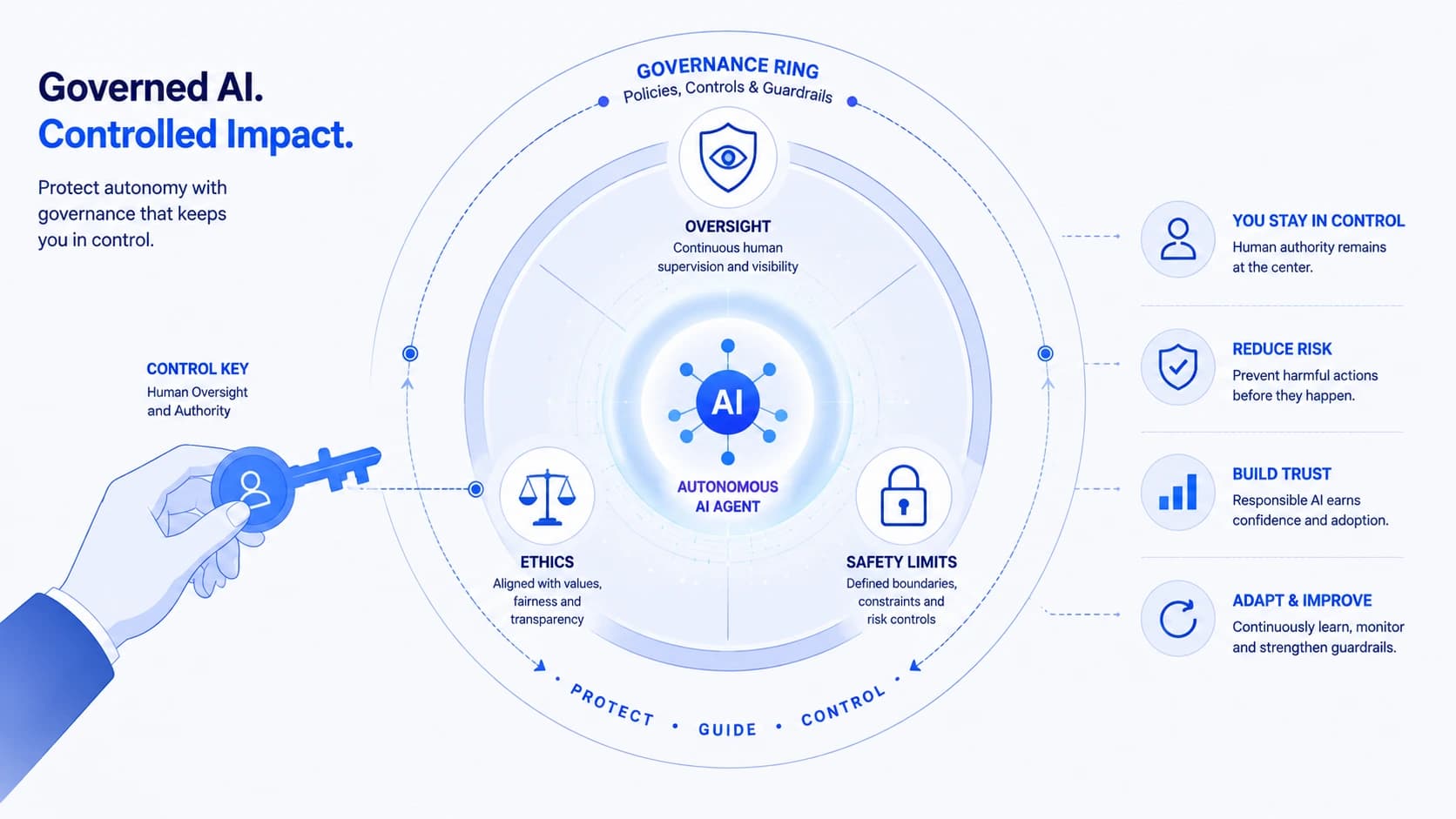
AI Governance for Autonomous Agents: Keeping Control When Software Acts on Its Own
Learn how to govern autonomous AI agents with clear policies, guardrails, and audit trails — so agents stay useful without going off-script.