
The Future of Hotel Guest Experience: How AI Agents Automate Pre-Arrival Communication
Learn how AI agents can automate hotel pre-arrival communication while keeping guest requests coordinated, timely, and human-aware.
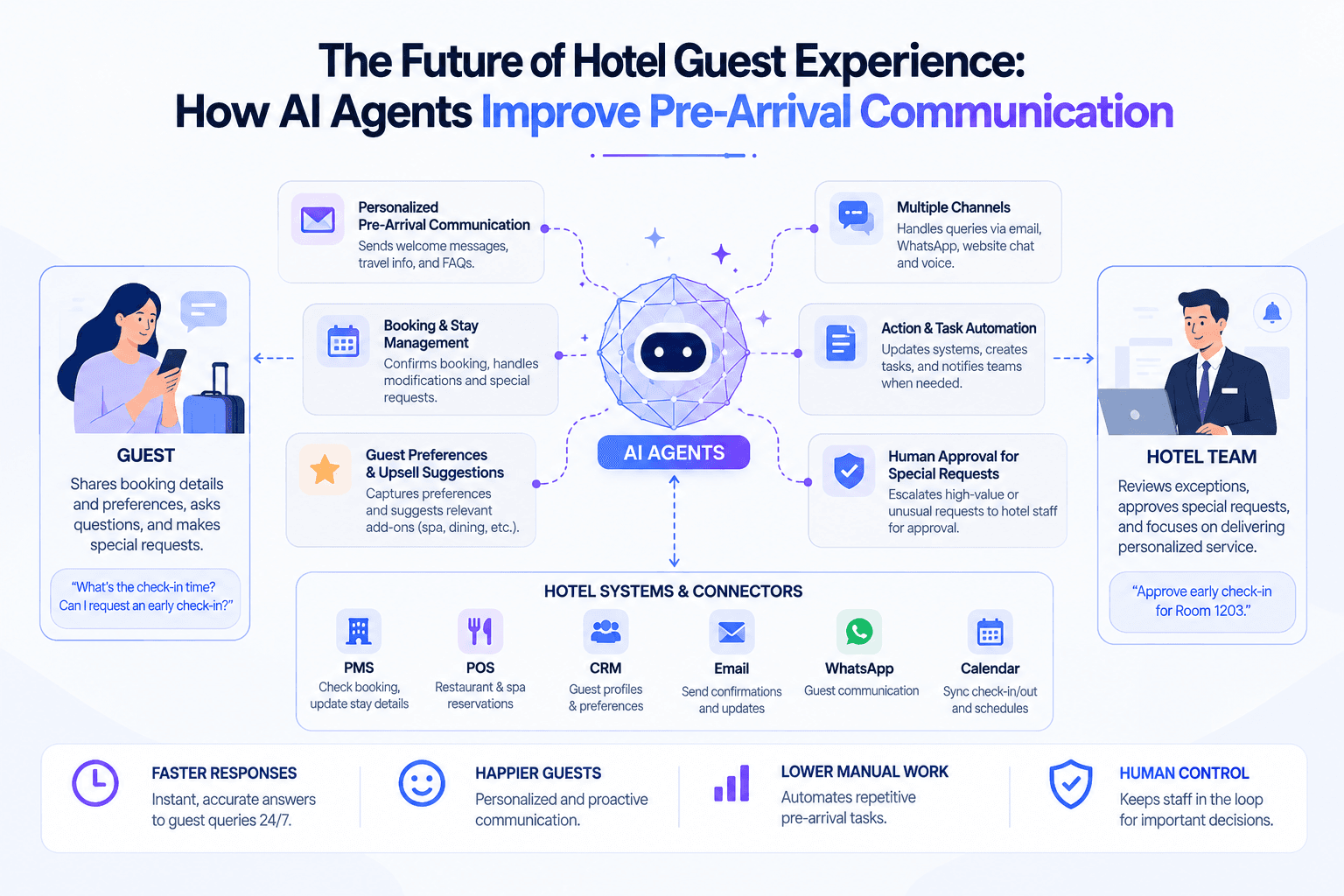
I’ve seen hotels lose the guest experience before the guest even reaches the lobby.
A reservation is confirmed, but the airport pickup question sits unanswered. A special request is buried in email. The front desk discovers an anniversary note only when the guest is already checking in.
The stay has not started yet, but the service gap has.
That is why AI agents for hotel pre-arrival communication can be so valuable: they help hotels coordinate routine communication before arrival without forcing staff to manually manage every message, reminder, and follow-up.
The Guest Experience Starts Before Check-In
Hotels often think of service as something that begins when a guest walks through the door.
For the guest, it starts much earlier.
Before arrival, they may want to know:
- What time can I check in?
- Can the hotel arrange an airport transfer?
- Can I request an early check-in?
- Is breakfast included?
- Can a room preference be noted?
- Can the hotel accommodate a special occasion?
- Where should I park?
- Can I modify part of my stay?
- Is there anything I need to provide before arrival?
Each question is simple on its own.
At scale, they create a coordination problem.
The hotel may need to read the request, understand what the guest needs, find the relevant information, route the request internally, respond, and make sure any promised action is actually followed through.
Why Pre-Arrival Communication Becomes Manual So Quickly
The problem is rarely that hotels do not communicate.
The problem is that communication is fragmented.
Guests do not send structured workflow tickets.
They send messages such as:
> “We’re arriving around 10 AM. Is there any chance of checking in early? Also, it’s our anniversary.”
One message can contain several different intents.
Someone has to interpret them.
Teams repeatedly answer questions about:
- check-in timing
- hotel policies
- arrival information
- amenities
- directions
- basic stay details
The answer may already exist.
But a staff member still has to read, locate, and send it.
A guest message may require action from:
- front desk
- housekeeping
- reservations
- concierge
- transport coordination
- another hotel team
Sending a reply is only half the job.
The request must reach the right operational owner.
The person receiving the request may not be working when the guest arrives.
Without a clear workflow, context can disappear between shifts.
A standard check-in question and a sensitive guest issue should not be treated the same way.
The workflow needs to know when automation is appropriate and when a person should take over.
Traditional Pre-Arrival Communication vs. Agent-Assisted Communication
The difference is not simply “manual email versus AI email.”
It is the difference between manually coordinating each guest interaction and using an agent-led workflow to manage routine communication while escalating the right exceptions.
| Pre-arrival activity | Traditional approach | Agent-assisted approach |
|---|---|---|
| Booking follow-up | Staff sends standard communication | Workflow can initiate the appropriate pre-arrival communication |
| Guest email | Staff reads every message manually | Communication agent interprets the request |
| Routine question | Staff searches and replies | Agent prepares or sends the relevant response within its scope |
| Multiple requests in one message | Staff separates them manually | Workflow can break requests into distinct actions |
| Internal handoff | Email, note, call, or chat | Workflow routes the request to the appropriate step |
| Follow-up | Staff remembers to check | Workflow tracks the next required action |
| Exception | Staff identifies it manually | Agent routes the case to human review |
| Context at arrival | May depend on notes or staff memory | Structured workflow can preserve the relevant pre-arrival context |
The goal is not to automate hospitality.
It is to automate the repetitive coordination around hospitality.
Guest Communication Agents Should Handle the Routine, Not Pretend Every Request Is Routine
A guest communication agent can be useful when the request is well understood and within a clearly defined scope.
Good examples include:
- answering standard pre-arrival questions
- confirming that a request has been received
- asking for missing information
- sending arrival reminders
- preparing check-in information
- routing special requests
- following up on unresolved pre-arrival actions
- summarizing the guest's requests for staff
But some conversations need a person.
Examples may include:
- complaints
- unusual exceptions
- sensitive situations
- requests outside hotel policy
- unclear or contradictory instructions
- situations where the hotel cannot confidently commit to the requested outcome
This is where Nuroen AI Guest Communication Agents can fit naturally: routine communication can be handled through a defined agent workflow, while cases outside that scope can move to staff.
The agent supports hospitality.
It should not impersonate judgment it does not have.
Email Is Not Just a Channel — It Is a Workflow Trigger
For many hotels, email remains an important pre-arrival communication channel.
The mistake is treating it only as a mailbox.
An incoming message can be the start of a workflow.
For example:
Guest email received
→ identify booking context
→ identify guest intent
→ determine whether the request is routine
→ prepare response
→ route operational request if required
→ escalate if human judgment is needed
→ track follow-up
This is where Nuroen AI Email Integration can help at the communication layer.
Instead of staff manually monitoring every message and deciding what to do next, the email can become an input into a structured guest-service workflow.
The useful question is not:
> Can AI write the email?
It is:
> Can the guest request move to the correct next step after the email arrives?
Workflow Orchestration Connects Communication to Operations
A fast response is useful.
A fulfilled request is better.
Suppose a guest asks:
> “Can you arrange an airport pickup and note that we will arrive after 9 PM?”
There are at least two separate actions:
- respond to the guest
- make sure the operational request reaches the right internal workflow
If an AI system only drafts a polite reply, the hotel still has a coordination problem.
Nuroen AI Workflow Orchestration can help connect communication steps with the next required action.
A workflow could look like:
Guest request
→ communication agent interprets message
→ classify requests
→ route transport request
→ record late-arrival context
→ prepare confirmation
→ wait for required internal response
→ update guest communication
That is much more useful than simply generating text.
A Multi-Step Guest Request Should Not Be Treated as One Message
Consider this email:
> “Hi, our flight lands at 7:30 PM. Can someone arrange a pickup? We are travelling with a child, and if possible we would also like a quiet room.”
That message contains multiple needs:
- arrival timing
- transportation
- family context
- room preference
A useful guest communication workflow should separate them.
For example:
Understands the message and identifies the individual requests.
Handles the airport-transfer request.
Passes the room preference to the appropriate hotel process.
Preserves the relevant arrival and family information for staff.
Handles anything the agent cannot confidently resolve.
This is where agent orchestration becomes more important than message generation.
A Concrete Example: Anniversary Stay With an Early Arrival
Consider a fictional couple staying at a city hotel for an anniversary weekend.
Three days before arrival, the guest sends:
> “We’ll reach the hotel around 11 AM. Is early check-in possible? It’s also our anniversary, so please let us know if anything special can be arranged.”
A staff member may need to:
- open the email
- find the reservation
- understand the early check-in request
- note the anniversary
- check what can be promised
- contact another team if necessary
- respond to the guest
- record the request somewhere
- make sure the arrival team sees the information
- follow up if confirmation is still pending
The guest asked one question.
The hotel received several operational tasks.
The Guest Communication Agent identifies:
- arrival time
- early check-in request
- anniversary context
The workflow separates the requests.
The early check-in request moves into the appropriate operational path.
The anniversary information is preserved for the relevant team.
If the hotel cannot automatically confirm the request, the workflow routes it to a staff member instead of making an unsupported promise.
Once the required response is available, the guest communication can continue.
The value is not that an AI writes a nicer anniversary message.
The value is that the guest's message becomes coordinated action.
Do Not Let Automation Promise What Operations Cannot Deliver
This is one of the most important rules in hospitality automation.
An agent should not convert a request into a promise unless the workflow supports that commitment.
There is a big difference between:
> “We have noted your early check-in request.”
and:
> “Your room will be ready at 11 AM.”
The second statement creates an operational commitment.
If the agent does not have reliable confirmation, it should not make that promise.
A well-designed workflow should distinguish between:
- request received
- request routed
- request pending
- request confirmed
- request declined
- request requiring human review
This is where Nuroen AI Workflow Orchestration and Guest Communication Agents can work together: communication can reflect the actual state of the request rather than generating a plausible but unsupported answer.
Personalization Should Come From Context, Not Guessing
Hotels often want AI to make communication feel more personal.
That can be useful.
But personalization should be grounded in information the hotel actually has.
Good personalization can use available context such as:
- guest name
- stay dates
- confirmed reservation details
- guest-provided requests
- verified preferences available to the workflow
- status of an existing request
Bad personalization invents details.
The rule should be simple:
Use known context. Do not manufacture familiarity.
That protects both credibility and guest trust.
The Best Automation Knows When to Hand Off
Not every guest interaction should stay automated.
A workflow should escalate when:
- the request is unclear
- the agent lacks the required information
- policy is ambiguous
- a complaint or sensitive issue appears
- the guest requests something outside the configured scope
- the hotel needs to make a discretionary decision
- the operational team cannot confirm the requested service
A human handoff is not a failure.
It is part of good workflow design.
The agent's job is to make that handoff better by preserving:
- the original message
- identified requests
- booking context
- work already completed
- unresolved questions
- the next decision required
That prevents the guest from having to explain everything again.
What Hotel Leaders Should Define Before Automating
Before introducing guest communication agents, define the operating boundaries.
A practical checklist includes:
- which pre-arrival emails are in scope
- which questions can receive automated responses
- what reservation context the workflow may use
- which guest requests require internal routing
- what the agent may confirm
- what the agent may only acknowledge
- what requires staff approval
- what situations must always escalate
- how unresolved requests are tracked
- what context should be available at check-in
- what happens if the workflow cannot complete a request
The objective is not maximum automation.
It is dependable guest service.
Step-by-Step: Building a Pre-Arrival Guest Communication Workflow
A practical rollout can start with one narrow journey.
Define when the workflow should begin.
For example, focus on the period between confirmed reservation and check-in.
Review the most frequent pre-arrival questions and requests.
Typical categories may include:
- arrival timing
- check-in questions
- transportation
- room preferences
- special occasions
- basic hotel information
Do not start with every possible guest interaction.
Use Nuroen AI Guest Communication Agents for a clearly bounded set of tasks.
Specify:
- allowed response types
- information sources
- escalation conditions
- situations where the agent must not make a commitment
Use Email Integration so incoming pre-arrival communication can trigger the appropriate workflow rather than waiting for manual mailbox review.
For every common request, define the next action.
For example:
Routine information request → respond
Operational request → route internally
Missing information → ask guest
Unclear request → human review
Sensitive issue → escalate
Use Workflow Orchestration when one message contains several requests or when fulfilment depends on another team.
Do not treat the guest reply and the operational task as the same step.
Specify when a staff member must take over.
The handoff should include all relevant context so the guest does not need to repeat the request.
Test scenarios involving:
- multiple requests in one email
- incomplete information
- unusual arrival times
- requests the hotel cannot confirm
- follow-up messages
- contradictory requests
- sensitive complaints
- guest changes after an earlier confirmation
Useful measures may include:
- pre-arrival response time
- staff handling time
- number of manual handoffs
- unresolved pre-arrival requests
- repeat guest follow-ups
- request fulfilment time
- percentage of requests requiring human intervention
[BENCHMARK: insert verified pre-automation and post-automation guest communication metrics.]
Once routine pre-arrival communication works consistently, expand carefully into additional guest journeys.
The objective should be a better experience, not simply a higher automation rate.
What Good Pre-Arrival Automation Should Feel Like
For the guest, the experience should feel simple.
They send one message.
They receive a relevant response.
They do not need to repeat the same request.
They know when something is confirmed and when it is still pending.
For hotel staff, the workflow should make it easy to understand:
- what the guest asked for
- what has already been answered
- which internal action is pending
- who owns the next step
- whether anything needs human attention
- what context matters before arrival
If automation creates more checking for staff, it has missed the point.
Why This Matters
Hospitality is built on attention.
Guests remember when a hotel seems prepared for them.
They also remember when they have to repeat a request three times.
AI agents can help hotels handle more of the repetitive communication and coordination that happens before arrival.
But the goal should not be to make the experience feel automated.
The goal should be the opposite.
Use automation to remove operational friction so staff have more room for the moments where genuine hospitality matters.
That is the real opportunity in AI-powered pre-arrival communication: faster coordination behind the scenes, with a smoother experience in front of the guest.
For hotel leaders exploring this model, Explore Hospitality AI Agents with Nuroen AI.
Placeholders to Complete Before Publishing
- [BENCHMARK: insert verified pre-automation and post-automation guest communication metrics.]
Add only verified internal, pilot, customer, or independently sourced performance data.
Optional if available:
- [CUSTOMER STORY: add an approved hotel or hospitality pre-arrival automation example.]
Include only if the customer or deployment can be publicly referenced.
Related essays
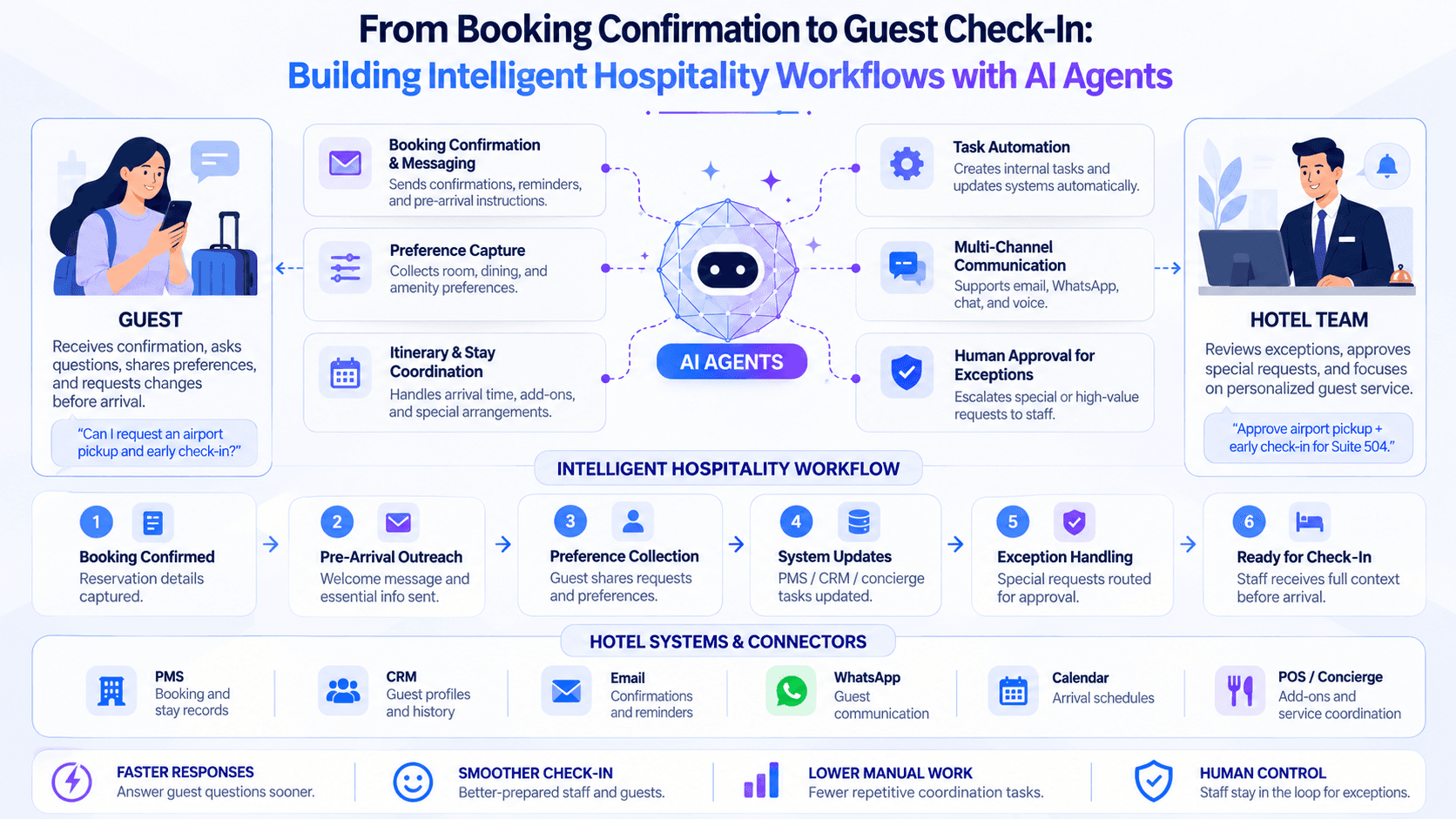
The Future of Hotel Guest Experience: How AI Agents Orchestrate Pre-Arrival Operations
Learn how AI agents can coordinate pre-arrival hotel workflows, connect enterprise systems, and keep sensitive guest decisions under human control.
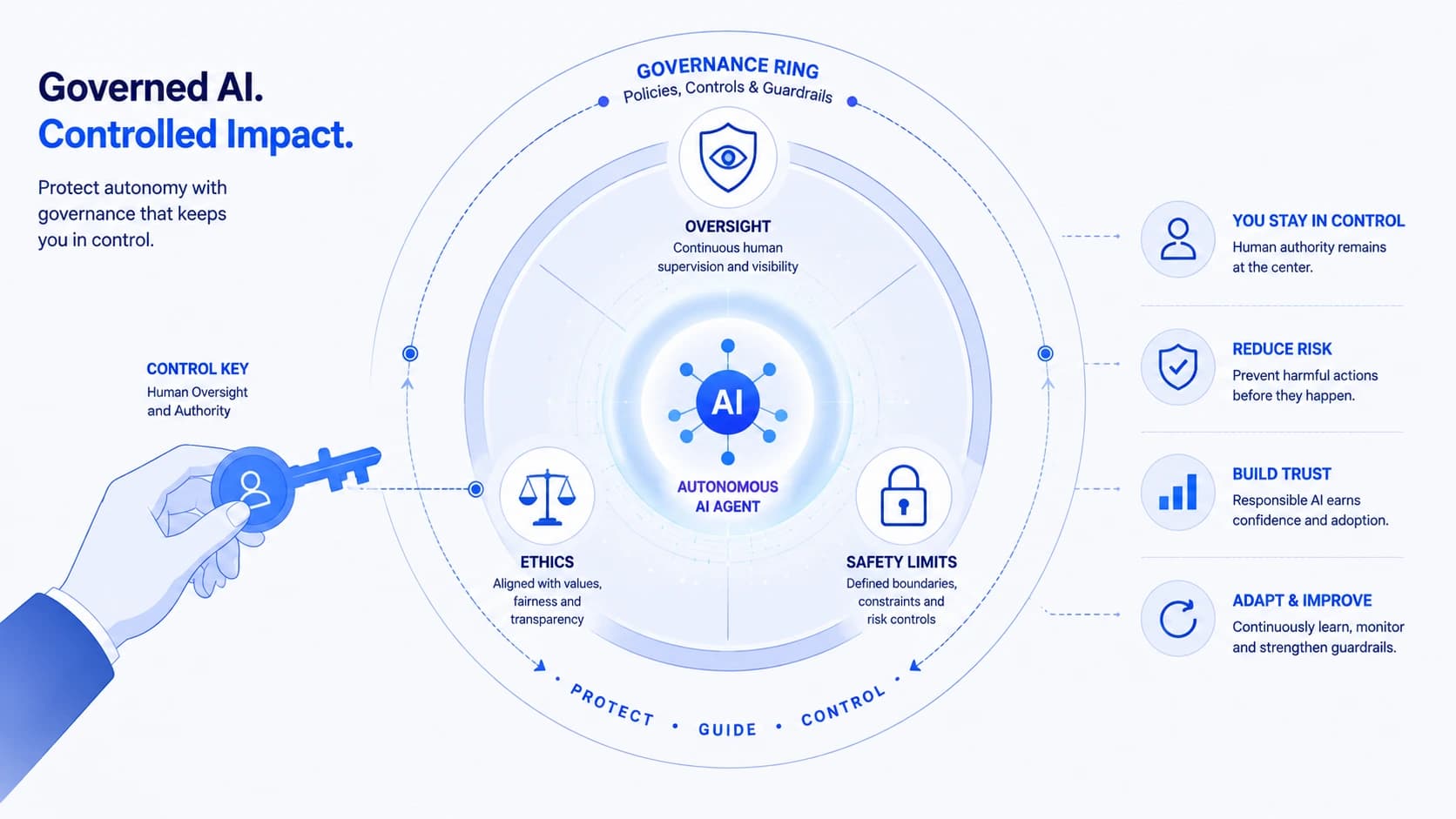
AI Governance for Autonomous Agents: Keeping Control When Software Acts on Its Own
Learn how to govern autonomous AI agents with clear policies, guardrails, and audit trails — so agents stay useful without going off-script.