
The Future of Hotel Guest Experience: How AI Agents Orchestrate Pre-Arrival Operations
Learn how AI agents can coordinate pre-arrival hotel workflows, connect enterprise systems, and keep sensitive guest decisions under human control.
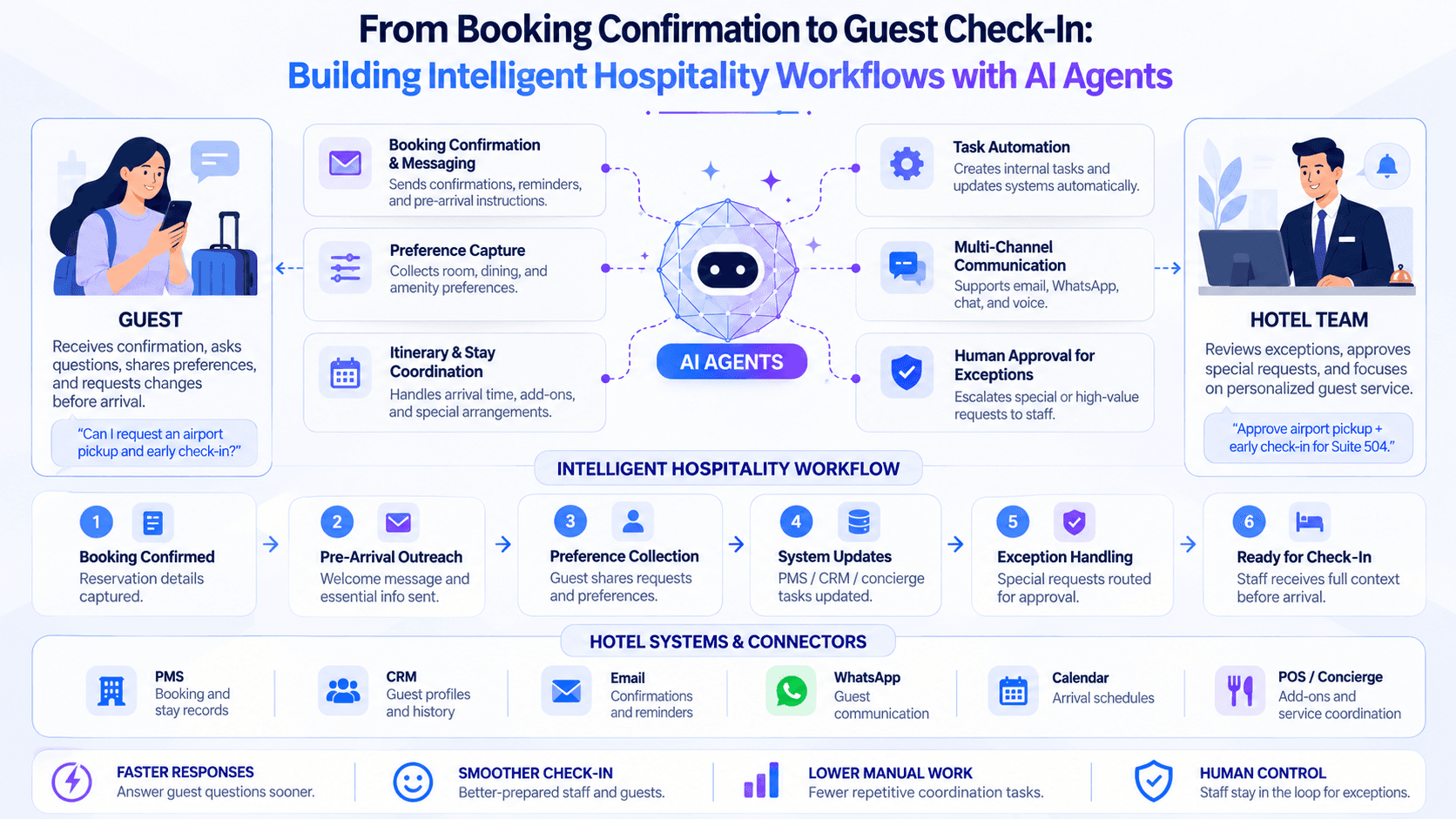
I’ve seen hotel teams lose time on guest requests that look simple from the outside.
A guest asks for airport pickup, early check-in, and a room preference in one message. Reservations sees one part. Front desk sees another. Someone still has to make sure the full request is handled before arrival.
The guest experiences one conversation.
The hotel experiences several workflows.
That is where AI agents for hotel pre-arrival operations can help: not by replacing hospitality teams, but by coordinating the operational work behind the guest experience.
Pre-Arrival Service Is an Operations Problem Disguised as a Communication Problem
A pre-arrival message may look like an email.
Operationally, it can trigger several different tasks.
A single guest request might involve:
- reservation context
- arrival timing
- transportation
- room readiness
- room preferences
- special-occasion notes
- hotel policy
- internal approvals
- follow-up communication
- staff handoff before check-in
The communication is only the visible layer.
Behind it sits an operational workflow.
That is why simply adding an AI email assistant does not solve the larger problem.
The real question is:
> Can the hotel coordinate all the work created by the guest's message without relying on staff to manually move every request between teams?
Why Pre-Arrival Requests Break Across Hotel Teams
Most hotel teams already have systems for reservations, communication, guest records, and internal operations.
The friction appears between them.
Consider:
> “Our flight lands at 8 PM. Can you arrange a pickup, note that we are travelling with a child, and see if a quiet room is possible?”
That message is not one task.
It contains:
- arrival information
- transport request
- family context
- room preference
Someone has to separate those requests and route them correctly.
Front desk may own one part.
Reservations may own another.
Transport or concierge may own something else.
A guest does not care about the hotel's organizational structure.
They expect one coherent experience.
A hotel may be able to record an early check-in request immediately.
That does not mean it can confirm the room will be ready early.
The workflow must distinguish between:
- received
- requested
- pending
- approved
- confirmed
- unavailable
That distinction is operationally important.
The person receiving the request may not be the person working when the guest arrives.
If context is stored only in an inbox or informal message, the arrival team may never see it.
Routine information can often follow a standard path.
Requests involving policy exceptions, special handling, sensitive complaints, or operational constraints may need a human decision.
A good automation system needs to know the difference.
Traditional Hotel Automation vs. Multi-Agent Orchestration
The difference is not simply whether AI is present.
It is whether the workflow can coordinate multiple responsibilities around the same guest.
| Pre-arrival activity | Traditional workflow | Multi-agent workflow |
|---|---|---|
| Guest request arrives | Staff reads the message | Master agent starts the workflow |
| Request interpretation | One person identifies all tasks | Specialist agents handle defined request types |
| Booking context | Staff checks another system | Relevant enterprise data can be brought into the workflow |
| Transport request | Manual forwarding or message | Routed to the appropriate child workflow |
| Room preference | Added manually if remembered | Routed as a separate task |
| Policy exception | Staff decides whom to ask | Workflow pauses for human approval |
| Follow-up | Staff tracks manually | Master agent tracks unresolved steps |
| Guest response | Written after internal coordination | Response can reflect actual workflow status |
| Arrival handoff | Notes, email, or staff memory | Structured context can remain available to the next stage |
The goal is not to create more agents.
The goal is to make ownership and handoffs explicit.
Why a Master/Child Agent Model Fits Hotel Operations
A hotel guest often experiences one request that touches several operational domains.
That makes a master/child model useful.
The master agent should not try to do every task itself.
Its job is to understand the overall request, coordinate specialist agents, track status, and determine when the workflow is complete.
The child agents handle narrower responsibilities.
For example:
Handles routine guest-facing communication within the defined scope.
Prepares the reservation information needed by the workflow.
Handles arrival timing or transportation-related workflow steps.
Processes requests such as room preferences or other pre-arrival notes.
Identifies when a request falls outside the normal path and needs review.
Tracks unresolved requests and ensures the workflow does not end simply because the first reply was sent.
With Nuroen AI Master/Child Agent Orchestration, these responsibilities can be separated while still operating as one coordinated guest journey.
The master agent manages the process.
The child agents handle the work they are designed for.
Enterprise Connectors Make the Workflow Operational
An agent can only coordinate a real hotel workflow if it has access to the information required for the current step.
That information may live across enterprise systems.
The important question is not:
> How many systems can we connect?
It is:
> Which system contains the information needed to make this step useful?
For example, the workflow may need access to:
- reservation context
- guest-provided information
- internal operational records
- communication channels
- other approved enterprise data required by the process
This is where Nuroen AI Enterprise Connectors can help.
The connector gives the agent workflow access to relevant enterprise context.
The orchestration layer decides how that information is used.
A useful pattern looks like:
Guest request
→ identify required context
→ retrieve approved enterprise information
→ route to specialist child agent
→ collect result
→ determine whether approval is needed
→ update the guest-facing workflow
The connector supports the operation.
It does not replace the operational design.
Human Approvals Protect the Difference Between a Request and a Commitment
Hospitality teams make commitments that affect real operations.
That means some actions should not be fully automated.
Consider the difference between:
> “We have noted your late check-out request.”
and:
> “Your late check-out is confirmed until 3 PM.”
The second statement is a commitment.
If the workflow does not have reliable authorization to make that commitment, it should not do so.
This is where Nuroen AI Human Approvals can fit into the workflow.
For example:
Guest requests exception
→ child agent prepares request
→ master agent identifies approval requirement
→ workflow pauses
→ authorized staff member approves or rejects
→ guest communication resumes with the correct status
Human approval is not a break in the automation.
It is part of the automation design.
One Guest Message Can Become Several Parallel Workflows
This is where orchestration becomes more valuable than a simple chatbot.
Consider:
> “We land at 6 PM. Could you arrange airport pickup? We are celebrating our anniversary, and if possible we would like a quiet room away from the elevator.”
The hotel now has multiple tasks.
The master agent can split the message into separate workflows.
Capture the guest's arrival timing.
Route the airport-pickup request to the appropriate child process.
Preserve the anniversary information for the relevant team.
Route the quiet-room preference separately.
The master agent tracks all four.
The guest still experiences one conversation.
That is the point.
Multi-agent orchestration should hide operational complexity from the guest, not expose it.
A Concrete Example: Late Arrival, Airport Pickup, and Early Breakfast
Consider a fictional business traveller arriving at a hotel for an important meeting.
The guest emails:
> “My flight now lands at 11:15 PM. Can you arrange an airport pickup? I also need to leave by 6:30 AM, so please let me know whether breakfast can be arranged early.”
A team member may need to:
- find the reservation
- note the late arrival
- forward or coordinate the pickup request
- check whether the breakfast request can be accommodated
- wait for internal responses
- update the guest
- record the late-arrival context
- make sure the night team sees it
- follow up if one request is still unresolved
The guest sent one message.
The hotel created several dependencies.
The Master Agent identifies three tasks:
- late-arrival context
- airport pickup
- early-breakfast request
The Arrival Coordination Child Agent handles the arrival context.
The relevant service child workflow handles the pickup request.
Another child workflow handles the breakfast request.
If one request requires authorization or cannot be confirmed automatically, the workflow reaches a Human Approval step.
The Master Agent keeps the overall guest request open until the necessary child workflows return a status.
The final communication reflects what is actually:
- confirmed
- pending
- unavailable
- waiting for human review
This matters because a good guest experience depends on accurate coordination, not just a fast reply.
The Master Agent Should Coordinate, Not Guess
A master agent should have a clear role.
It should know:
- what the guest asked for
- which child agent owns each task
- what context each child agent needs
- which tasks can run in parallel
- which task depends on another result
- whether a human approval is required
- which requests remain unresolved
- when the guest can receive a final response
It should not guess operational facts simply to complete the conversation.
For example, if a child workflow cannot confirm airport transfer availability, the master should not turn “pending” into “confirmed.”
A trustworthy workflow preserves state accurately.
That is more important than making every interaction look instantaneous.
Child Agents Should Have Narrow Responsibilities
The easiest way to make a multi-agent workflow unreliable is to give every child agent a broad mandate.
A stronger design gives each agent a narrow job.
For each child agent, define:
- trigger
- allowed inputs
- required context
- task
- possible outcomes
- escalation condition
- output passed back to the master
For example:
Room Preference Child Agent
Trigger: Guest requests a room preference.
Input: Reservation context + guest preference.
Task: Route and record the preference through the configured process.
Possible outcomes: Recorded / requires review / unavailable.
Escalation: Human review when the request cannot be handled within the defined process.
Output to master: Current status and guest-safe response context.
This structure makes orchestration easier to understand and test.
The Workflow Should Preserve Guest Context Across Handoffs
Automation should not create the classic frustration:
> “Can you explain the issue again?”
When a guest request moves from an agent to a human, the relevant context should move with it.
A strong handoff includes:
- guest request
- reservation context used
- individual tasks identified
- actions already completed
- current status of each request
- unresolved issue
- decision required from staff
That way the staff member joins the conversation with context.
The guest does not have to restart it.
Enterprise context and workflow state are therefore just as important as the generated response.
Not Every Request Should Be Automated
Hotel leaders should explicitly define the boundaries.
Potential candidates for routine automation may include:
- basic pre-arrival information
- request acknowledgement
- structured follow-up
- workflow routing
- status updates
- collection of missing information
Potential human-review cases may include:
- policy exceptions
- sensitive complaints
- unusual service recovery
- discretionary upgrades
- requests with unclear operational consequences
- commitments requiring staff authorization
- situations where required information is unavailable
The principle is simple:
automate coordination aggressively, automate judgment carefully.
What Hotel Operations Leaders Should Define Before Building
Before creating a multi-agent guest workflow, agree on the operating model.
A practical checklist includes:
- which pre-arrival requests are in scope
- which child agents are required
- which enterprise systems contain necessary context
- what each child agent may do
- what the master agent may decide
- which requests can be automatically acknowledged
- which requests can be automatically confirmed
- what requires human approval
- what counts as an exception
- how unresolved requests are tracked
- what context needs to reach the arrival team
- what happens when a child agent fails or cannot complete its task
The workflow should also define what the guest is told at each stage.
Operational status and guest communication should stay aligned.
Step-by-Step: Building a Master/Child Pre-Arrival Workflow
A practical rollout can start with one narrow pre-arrival journey.
Review the requests that arrive between reservation confirmation and check-in.
Group them into clear categories.
For example:
- arrival
- transportation
- stay preferences
- basic information
- special requests
Use Nuroen AI Master/Child Agent Orchestration to make the master responsible for:
- understanding the overall request
- delegating tasks
- tracking status
- coordinating responses
- handling unresolved dependencies
The master should not absorb every specialist task.
Create one narrow role for each major workflow category.
Each child agent should return a small set of well-defined outcomes.
Use Enterprise Connectors only where a workflow step needs access to approved information.
Avoid adding integrations without a clear operational purpose.
Some tasks can run at the same time.
Others depend on earlier results.
For example:
Arrival context and room preference may run in parallel.
A guest confirmation may need to wait until a service request returns a confirmed status.
Use Human Approvals for requests involving commitments, exceptions, or decisions that should remain with staff.
Define both approval and rejection paths.
The master agent should combine child-agent outcomes into a coherent response.
It should clearly distinguish:
- confirmed
- pending
- noted
- unavailable
- requires follow-up
Test realistic scenarios containing:
- three or more requests in one message
- conflicting requests
- missing booking information
- pending internal responses
- rejected approvals
- changes to earlier requests
- sensitive issues
Useful measures may include:
- pre-arrival response time
- staff handling time
- number of internal handoffs
- unresolved requests at check-in
- repeat guest follow-ups
- time waiting for internal approval
- percentage of requests escalated to staff
[BENCHMARK: insert verified pre-automation and post-automation hotel operations metrics.]
Once the first multi-agent journey is reliable, add more request categories or additional operational workflows.
Do not scale the number of agents faster than the hotel can govern their responsibilities.
What Good Hotel Operations Automation Should Feel Like
For the guest, it should feel simple.
One message.
One coherent experience.
Clear answers about what is confirmed and what is still pending.
For hotel staff, it should feel organized.
They should be able to see:
- what the guest requested
- which child workflow owns each task
- what has already been completed
- what still needs attention
- which action requires approval
- what information must be available at arrival
The complexity belongs behind the scenes.
That is exactly where orchestration should live.
Why This Matters
Hospitality is personal, but delivering it consistently is operational.
The guest sees one hotel.
They do not see reservations, front desk, transport coordination, internal systems, approval paths, or shift changes.
When those pieces fail to coordinate, the guest feels the friction.
Master/child agent orchestration offers a different model.
Specialist agents can handle defined tasks.
Enterprise connectors can bring the required operational context into the workflow.
Human approvals can protect the decisions that should remain with hotel staff.
And the master agent can keep the guest journey coherent across all of it.
The purpose is not to make hospitality autonomous.
It is to make hotel operations better coordinated so people can deliver better hospitality.
For hospitality operations and technology teams exploring that model, Book a Hospitality Automation Demo with Nuroen AI.
Placeholders to Complete Before Publishing
- [BENCHMARK: insert verified pre-automation and post-automation hotel operations metrics.]
Add only verified internal, pilot, customer, or independently sourced performance data.
Optional if available:
- [CUSTOMER STORY: add an approved hotel operations or guest-experience automation example.]
Include only if the customer or deployment can be publicly referenced.
Related essays
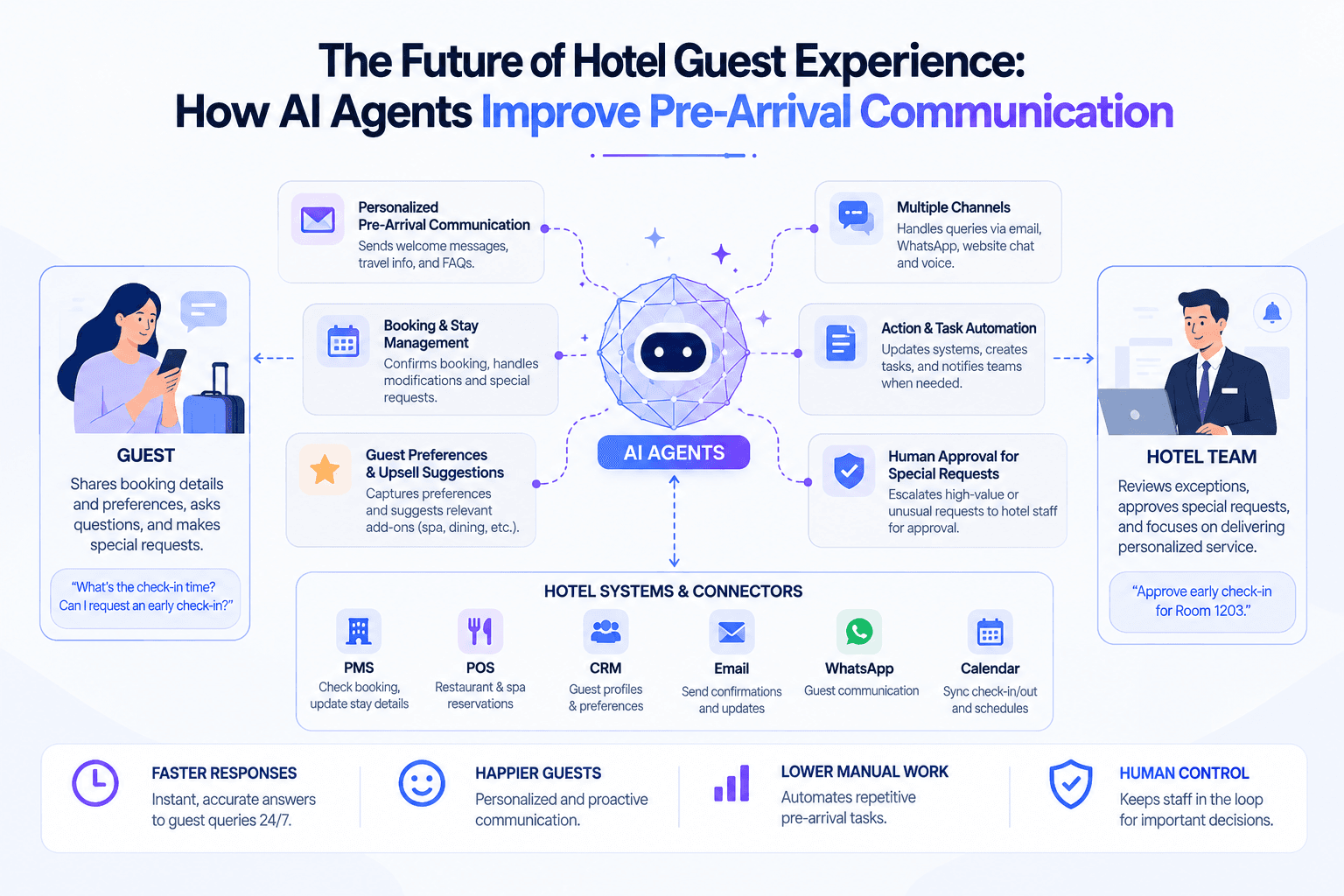
The Future of Hotel Guest Experience: How AI Agents Automate Pre-Arrival Communication
Learn how AI agents can automate hotel pre-arrival communication while keeping guest requests coordinated, timely, and human-aware.
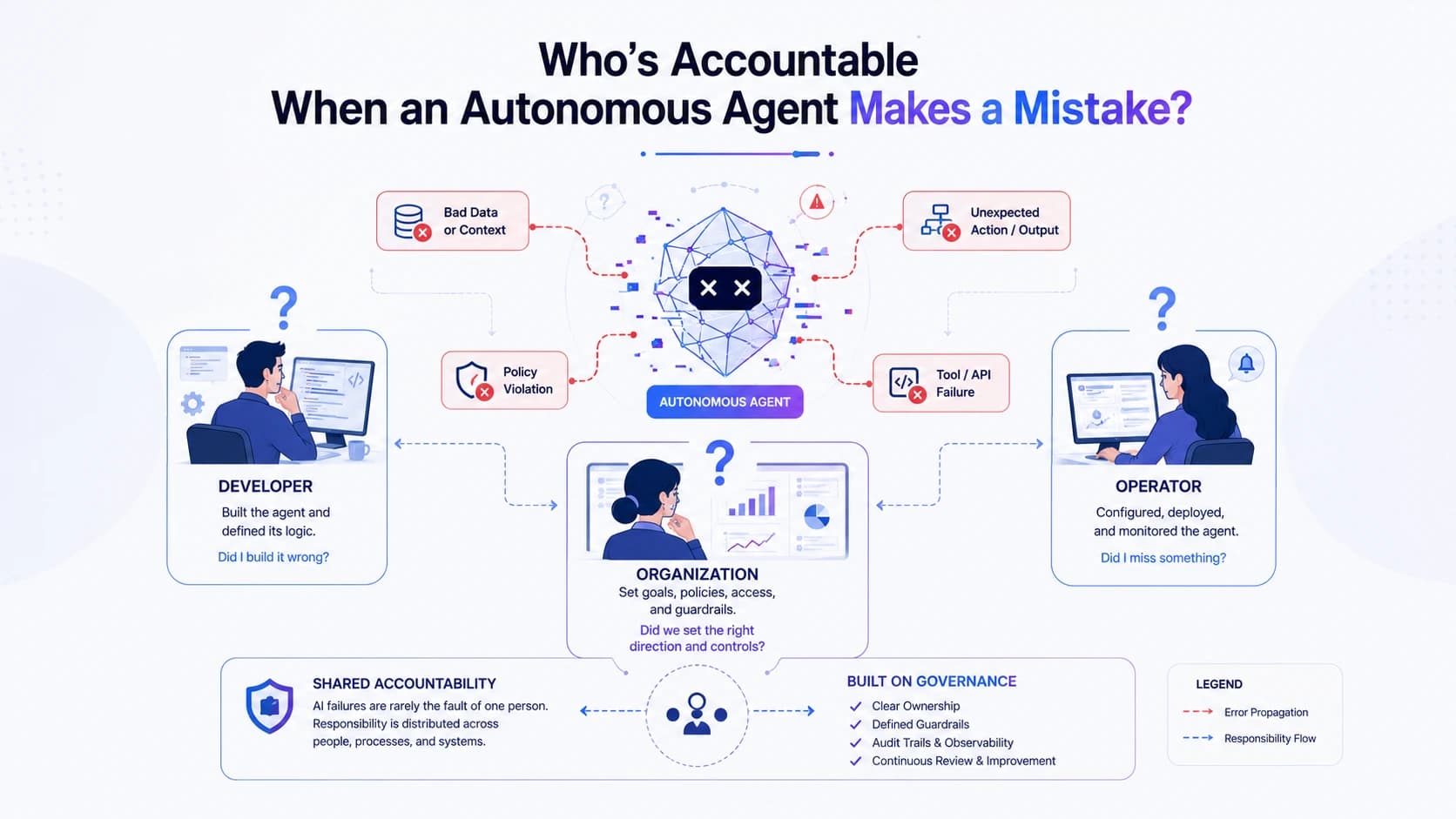
Who's Accountable When an Autonomous Agent Makes a Mistake?
Learn how to assign accountability for autonomous AI agents before something goes wrong — and why "the AI did it" is never an answer.